


AI-SDLC is a loose label for any software lifecycle with AI tools added to it: coding assistants, model-assisted linters, generated tests. AI-DLC, which Moring runs as an Agentic Delivery Lifecycle, is a governed operating model that spans requirement, code, review, test evidence, release, rollback, and audit trail, with a named owner and a structured record at every stage.
A naming note first, because a technical reader will check it. AWS coined "AI-DLC" on July 31, 2025 to mean the AI-Driven Development Life Cycle, an AI-native methodology built around three phases (Inception, Construction, Operations) and team rituals it calls Mob Elaboration and Mob Construction. That's the industry-standard reading of the acronym. Moring reuses the same three letters for a related idea, the Agentic Delivery Lifecycle, where the weight sits on governance evidence across delivery rather than on authoring rituals. Everywhere below, AI-DLC means that governed operating model. "AI-SDLC" has no single owner; IBM, consultancies, and academics all use it loosely for "AI integrated into the traditional SDLC."
Why does "AI-SDLC" fall apart the moment an auditor asks a question?
Because the label says nothing about controls. It covers a single Copilot seat and a full model-in-the-loop pipeline with equal vagueness, so it can't answer what a CTO actually gets asked: which governance control applied to code an agent wrote, another agent reviewed, and a pipeline shipped?
A governed operating model has to name who approves a change, what evidence each stage emits, and what a rollback records. The unit of accountability moves from the developer session up to the delivery lifecycle.
That gap is measurable. Retool's 2026 survey of 307 CTOs, CIOs, and CISOs, run with Wynter, found 93% concerned about AI-generated tools running in production, while only 4% had controls that reach AI-written code no matter which tool or path produced it. More than half, 51%, couldn't confirm whether an AI-generated tool had ever caused a production incident, and 22% had traced at least one such incident in the prior year. When half your leaders can't rule an incident in or out, what they're missing is a delivery record, and no model upgrade supplies it.
The Governed Workflow Spine runs seven stages, each with an owner, a handoff, and a record
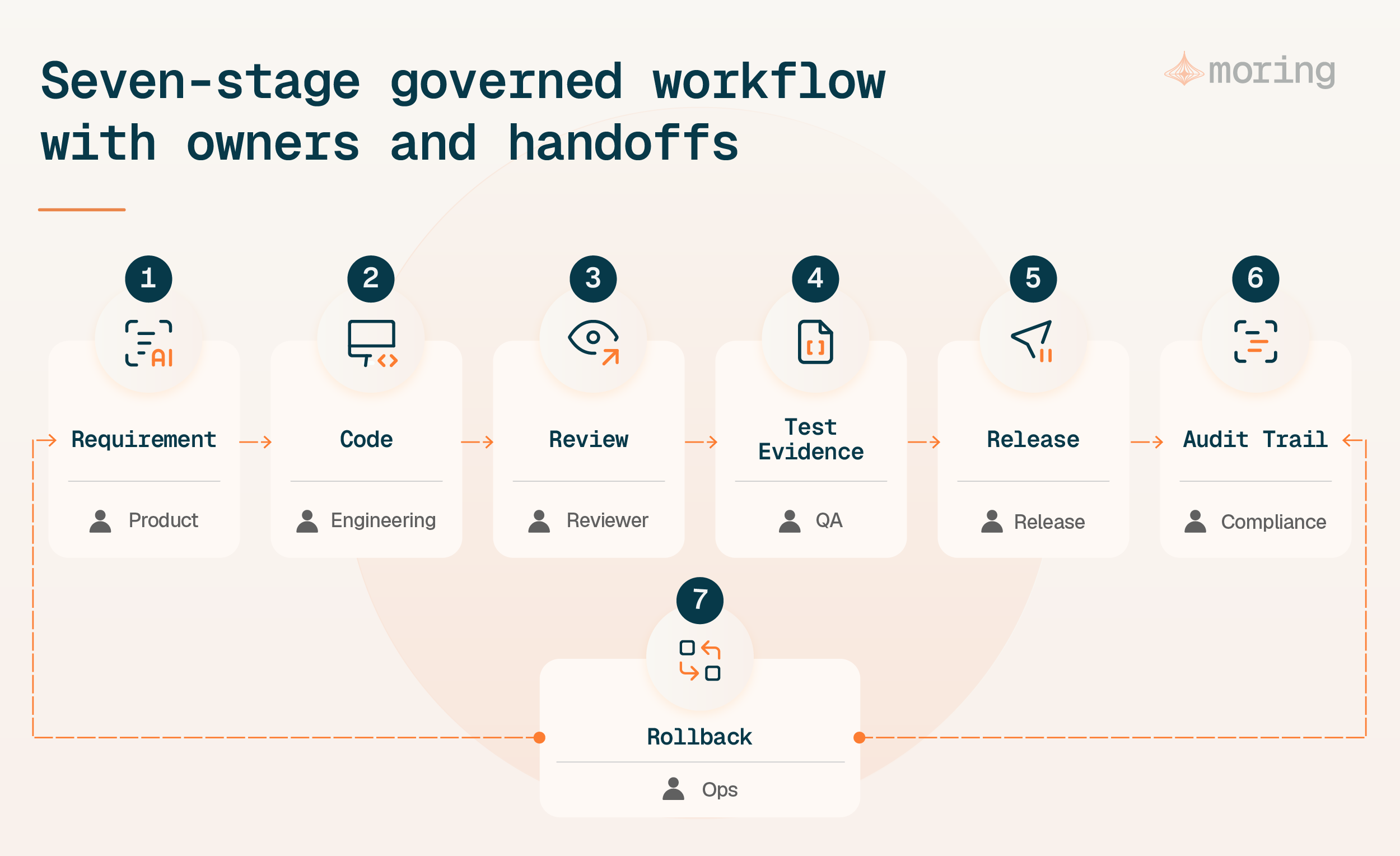
Seven-stage governed workflow with owners and handoffs
The spine is the ordered path requirement → code → review → test evidence → release → rollback → audit trail. Every hop assigns an owner and emits a structured artifact that survives into the next stage, so evidence accumulates as the work moves instead of being pieced together later from memory and chat history. Here's how a platform team would wire it.
Requirement. An agent turns the ticket into acceptance criteria stored as a versioned artifact, a YAML or JSON object keyed to the ticket ID, rather than a paragraph nobody can trace to. That ID becomes the anchor every downstream stage points back to, which is what turns "requirement-to-release traceability" from a slide into a query you can run.
Code. A generation agent works against encoded standards injected as context per stack: the house style guide, security patterns, the list of approved internal APIs. A call to a deprecated endpoint gets caught right here, before a human opens the diff. That's golden-path enforcement, where the platform refuses or reroutes a request that breaks a standard instead of hoping review catches it.
Review. A review agent drafts comments and flags issues; approval stays with a human, and the agent's draft and the reviewer's decision are stored as separate records. That human gate is the control that makes the trail defensible, and it's what SOC 2's CC8.1 change-management criterion expects: an authorize, test, approve trail naming who requested, approved, and implemented each change. An agent committing straight to main skips exactly that.
Test evidence. Tests are generated from the requirement artifact, so each one asserts against an acceptance criterion by ID. Generate them from the finished code instead and you just re-encode whatever the code already does, bugs and all.
Release. The pipeline assembles a release evidence pack: what changed, who reviewed it, which checks passed, and the rollback target captured at deploy time. That pack is the artifact you hand an auditor, in place of reconstructing the story from a dozen dashboards.
Rollback and audit trail. A revert records who authorized it and the commit state the system returned to. For anyone under the EU AI Act, this is where Article 12's automatic-logging duty for high-risk systems lands, with logs retained at least six months under Article 19.
What does a native audit trail actually contain?
Per agent action, it holds the requirement the change was written against, the exact model configuration used, the diff, the review verdict, the approver, and the linked test evidence. Concretely, the fields are:
- the requirement ID and a hash of the acceptance criteria the change targeted;
- the agent action itself: model ID and config (temperature, max tokens, tool permissions), the prompt version or hash, which MCP servers were attached, which context sources (repo files, ADRs, runbooks) were pulled in, and token counts;
- the diff and the files it touched;
- the review agent's draft comments, kept separate from the human verdict;
- the approver's identity, decision, and timestamp, plus the on-behalf-of delegation chain if the action ran under a delegated credential;
- test cases linked to the acceptance-criteria IDs, with pass or fail evidence;
- any override or exception, and who authorized it.
Two mechanisms keep those fields trustworthy. On-behalf-of identity gives an agent a delegated, scoped credential tied to a real developer and cost center, so the ledger attributes an action to a person instead of a shared service account. An MCP gateway restricts which tool servers an agent may attach, so a coding agent can't reach a production database because someone wired up a convenient connector over the weekend.
This is why a per-action ledger earns its keep over a pile of CI logs. CI output is unstructured text keyed by pipeline run, written for a human debugging a red build and usually rotated out within weeks. The ledger is structured, append-only, and keyed by agent action, with foreign keys to the requirement, the PR, the approver, and the model config. Ask it something real, like "show every change where an agent used a frontier model above temperature 0.4 against a payments requirement and a human overrode the review flag," and you get an exact answer. No grep over Jenkins output returns that, because the log never held the requirement class, the model config, or the override as first-class fields. Moring keeps the ledger queryable months later by treating every prompt, tool, model, and eval change as a versioned, tested, reversible artifact under the same CI/CD discipline as application code. That upward flow of evidence, with cost and quality signals travelling back to engineers and leaders while policy and context get injected down into each request, is what makes this a lifecycle rather than a gateway that forwards traffic and forgets it.
Why do DORA's four keys have to come from the delivery system, not the tool logs?
Because none of them can be read from a coding assistant's usage data. Deployment Frequency and Lead Time for Changes (committed to version control through deployed to production) come from your VCS and deploy events; Change Failure Rate and Failed Deployment Recovery Time come from linking incidents back to the deploys that caused them. Assistant logs report completion-acceptance rates and token counts, which say nothing about throughput or stability.
This matters because AI can push the metrics the wrong way. DORA's 2024 report found AI adoption lifted individual productivity and job satisfaction while denting delivery throughput and stability; the widely cited figures land at roughly a 1.5% drop in throughput and a 7.2% drop in stability per 25% increase in AI adoption, with 39% of respondents reporting little or no trust in AI-generated code. Watch only acceptance rates and you'll celebrate a productivity bump while change failure rate climbs behind it.
Why the CISO holds the veto, and what actually answers it
The CTO or VP Engineering usually signs the check, but the CISO can block any AI that touches source, standards, dependencies, or release evidence, and the block reduces to one demand: show me what the AI did, who approved it, and the system state at each step. Retool's data explains the caution. CISOs were far less positive on AI coding than CTOs, 47% net-positive against 71%, a 24-point gap, and 55% of leaders said security controls belong in a centralized platform instead of a policy document.
The controls that answer the demand are the ones already described: a human approval gate, an MCP gateway bounding what agents can reach, on-behalf-of identity so every action ties to a person, and a queryable ledger. One more belongs on the list. Evals run as CI, where a continuous harness scores a candidate model against your codebase before rollout, with regression detection and shadow-traffic A/B testing, so a model swap becomes a tested, reversible change rather than a surprise in production. Map these onto NIST's AI Risk Management Framework and its Govern function sits across the whole spine, informing Map, Measure, and Manage instead of acting as a one-time checkpoint.
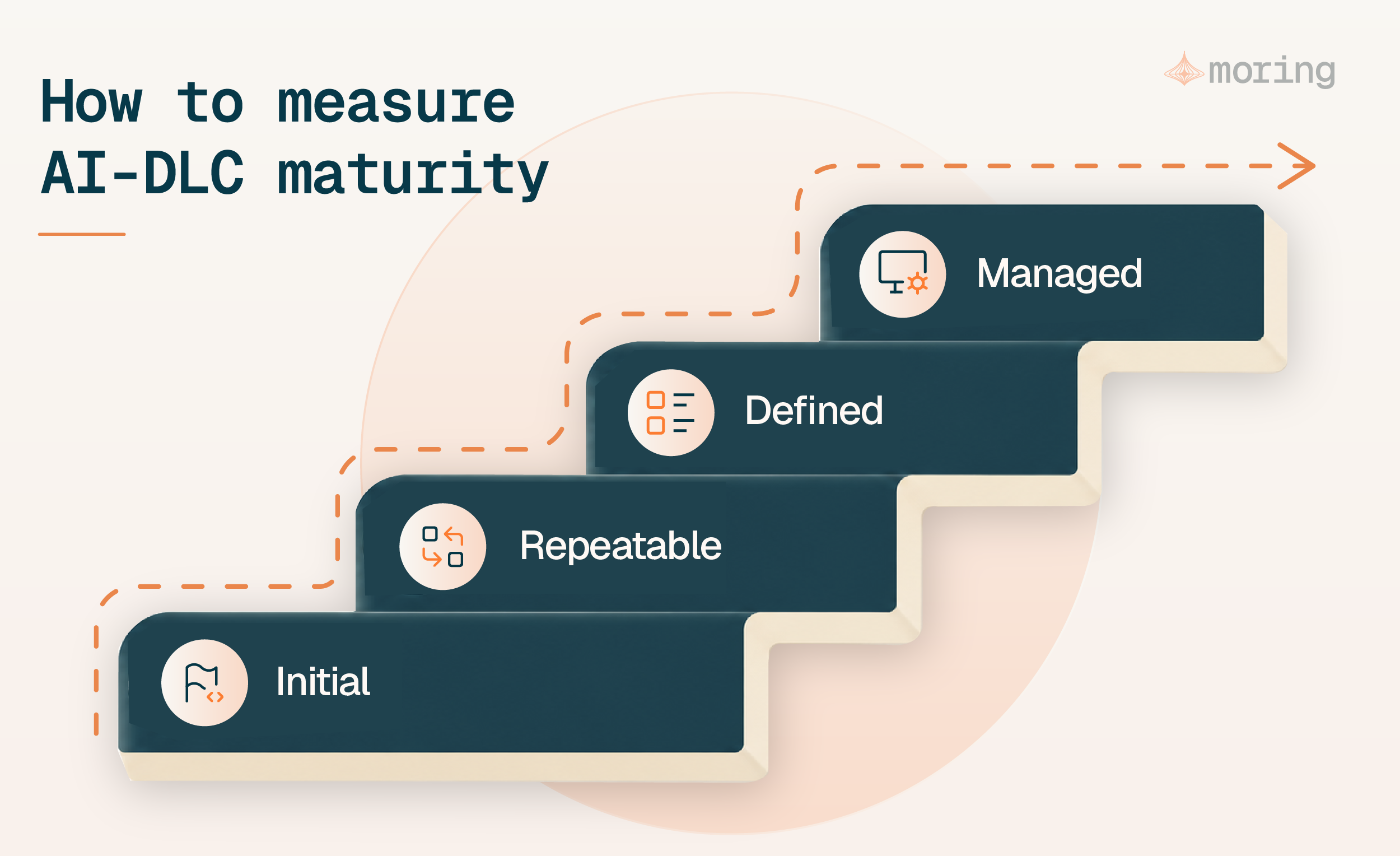
How to measure AI-DLC maturity
AI-DLC maturity measurement progression levels
Not by counting AI tools. A team with five assistants and no approval gate trails a team with one model and a fully instrumented spine, because maturity is coverage: how many stages emit a structured, traceable record with an owner. That coverage compounds, since every governed change feeds a knowledge loop, which standards get violated, which requirements generate rework, that ungoverned tooling throws away.
AI-DLC maturity self-assessment: seven controls to verify before you scale
- Requirement-to-release traceability. Can you join a deployed commit back to its acceptance-criteria ID?
- Review gate ownership. Does a named human approve every agent-contributed merge, with the agent barred from approving?
- Test evidence linkage. Do generated tests assert against requirement IDs, not just against code?
- Release evidence pack. Does each release record what changed, what passed, and the rollback target?
- Audit trail completeness. Does the record carry model config, prompt version, context sources, and approver identity?
- Rollback coverage. Does a revert capture who authorized it and the state returned to?
- DORA visibility. Are your four keys computed from VCS and incident data rather than assistant usage?
AI-SDLC vs AI-DLC: where the governance gap shows up
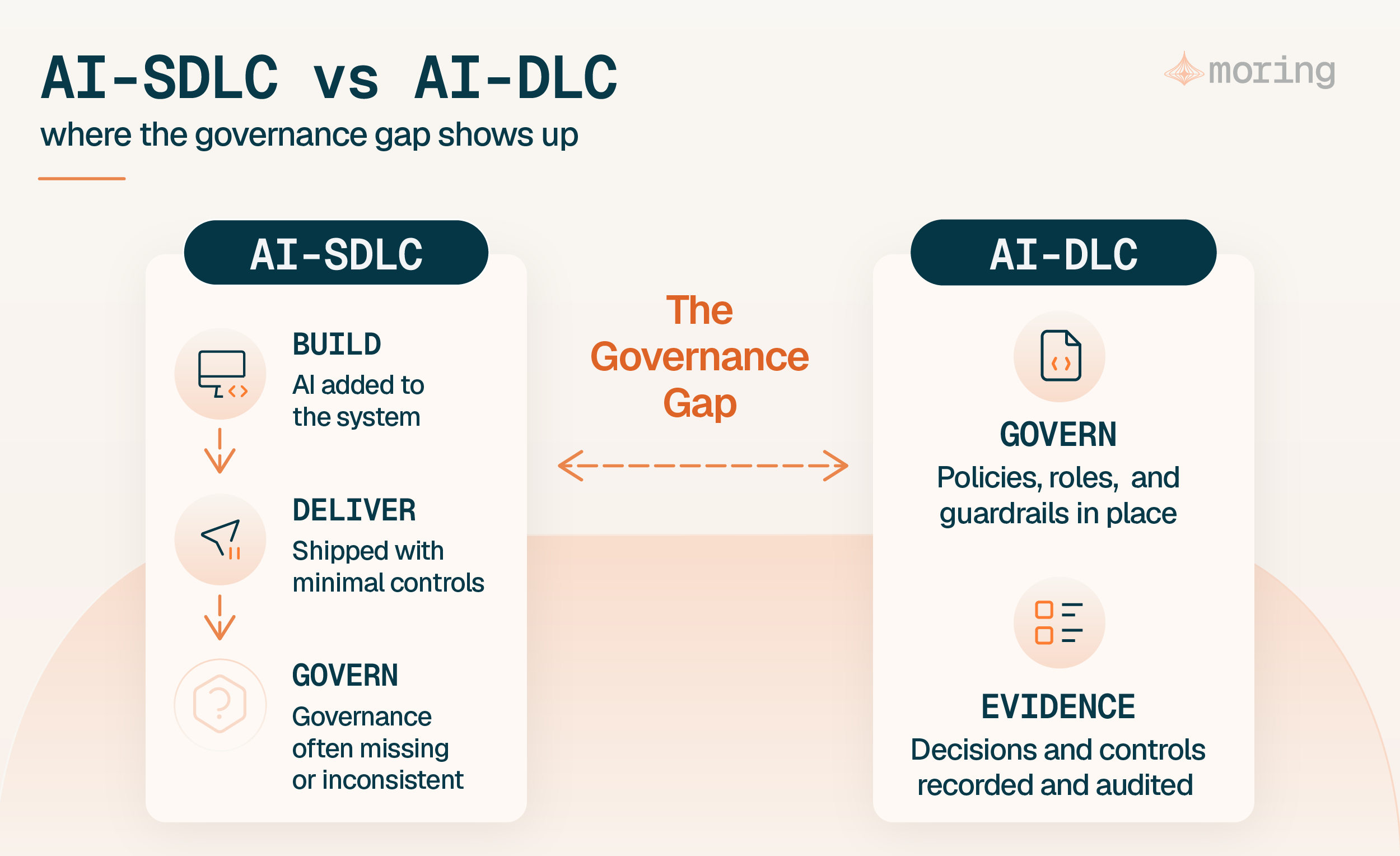
AI-SDLC vs AI-DLC governance gap comparison
Key takeaway
Once generating code is cheap, the scarce thing is a defensible record of who approved what and what it traces to. AI-SDLC tells you AI is in the loop somewhere. A governed AI-DLC makes that presence accountable, giving every stage of delivery an owner, a handoff, and a record an auditor can read months later. What closes the gap is governing the spine, not piling up more tools, so you can account for the code your teams ship rather than just watch it appear.
Frequently asked questions
What is the difference between AI-DLC and AI-SDLC?
AI-SDLC is an umbrella term for any lifecycle that has AI tools in it, with no single owner or defined controls. AI-DLC, in Moring's usage the Agentic Delivery Lifecycle, is a governed operating model that assigns an owner and a structured record to each stage from requirement to audit trail. AWS uses the same acronym for its AI-Driven Development Life Cycle methodology. The difference that matters day to day is accountability: whether you can show what an agent did and who signed off.
Why does the CISO need to approve AI in the delivery lifecycle?
The CISO can veto anything touching code, standards, dependencies, or release evidence, and the test is specific: can you reconstruct what the AI did, who approved it, and the system state at each step? Retool's 2026 survey found CISOs much more cautious than CTOs on AI coding, 47% net-positive versus 71%. A lifecycle that can't produce that record won't clear security review, whatever its velocity.
Can I use a coding assistant like GitHub Copilot and still have AI-DLC?
Yes. Assistants work at the session level and stay useful there. AI-DLC works at the delivery level, capturing requirement traceability, approvals, test evidence, and a per-action ledger that assistants don't emit. Keep the assistant for authoring speed and run the governed spine around it, so its output arrives traceable and auditable.
Which DORA metrics does a governed AI-DLC improve?
DORA's 2024 report found AI adoption can raise individual throughput while degrading delivery stability, around a 7.2% drop per 25% increase in adoption. A governed spine works on change failure rate and failed-deployment recovery time through review gates and rollback records, and it makes lead time and traceability computable from the evidence rather than estimated. The four keys are read from the delivery system, not from assistant usage.
What is the Governed Workflow Spine in AI-DLC?
It's the sequence requirement → code → review → test evidence → release → rollback → audit trail, where each stage has a named owner, a defined handoff, and a structured record. The spine is what lets you reconstruct any AI-contributed change end to end, which is the requirement behind SOC 2 CC8.1 change management and EU AI Act Article 12 logging.
→ Assess your AI-DLC maturity against the Governed Workflow Spine. Book the Moring AICP diagnostic at moring.ai/contact.
Sources
- AWS, "AI-Driven Development Life Cycle: Reimagining Software Engineering," AWS DevOps & Developer Productivity Blog (July 31, 2025).
- DORA, Accelerate State of DevOps Report 2024 (Google Cloud / dora.dev).
- NIST, AI Risk Management Framework 1.0 (NIST AI 100-1, January 2023).
- Retool, "The State of AI Governance in 2026," survey of 307 CTOs, CIOs, and CISOs conducted with Wynter (May 2026).
- European Union, Regulation (EU) 2024/1689 (EU AI Act), Articles 12 and 19.
- AICPA, Trust Services Criteria, criterion CC8.1 (change management).

