


Enterprise AI agent pilots succeed. Enterprise AI agent rollouts fail. The difference is not technical sophistication; it is governance infrastructure. When a VP of Engineering asks how to move from a working proof-of-concept to a production deployment that 200 developers can use safely, the answer is a 90-day rollout plan that builds control surfaces before scale. This plan takes one pilot team from ungoverned experimentation to production-grade operation in 30 days, adds routing and secrets gating in the next 30, and scales to a second team with durable telemetry in the final 30. It assumes you already have a working agent (Claude Code, GitHub Copilot Workspace, or equivalent), an executive sponsor, and the willingness to start narrow rather than attempting a company-wide launch on day one.
Why do most agent rollouts stall after the pilot?
Most organizations run a successful AI agent pilot, declare victory, and then watch adoption collapse the moment they try to expand beyond the original team. The failure mode is always the same: the pilot team operated under informal agreements enforced by senior engineers in the room. When you hand the same tool to a second team without those humans, the informal agreements evaporate. The second team generates code that violates architectural standards, leaks credentials into session context, or bypasses the security review process the first team honored by habit.
The root cause is that pilot-phase governance lives in people's heads, not in the agent's instruction set. A working rollout inverts this. It moves standards out of Slack threads and into files the agent reads at session start, builds routing that dispatches requests to specialist agents based on domain, and gates secrets so that UI work never loads database credentials. By day 90, governance is durable: it survives the departure of the original pilot team and scales to new teams without re-negotiating every standard from scratch.
What does a 90-day agent rollout plan actually contain?
A realistic rollout plan has three phases. Days 1–30 translate your existing informal standards into agent-readable files and session-level hooks. Days 31–60 add classification routing and secrets gating so that different request types trigger different handling automatically. Days 61–90 layer in audit telemetry and expand to a second team, proving that the governance you built is portable. Each phase produces a concrete artifact that the next phase builds on. You do not write a governance policy document in this plan. You write governance that the AI itself enforces.
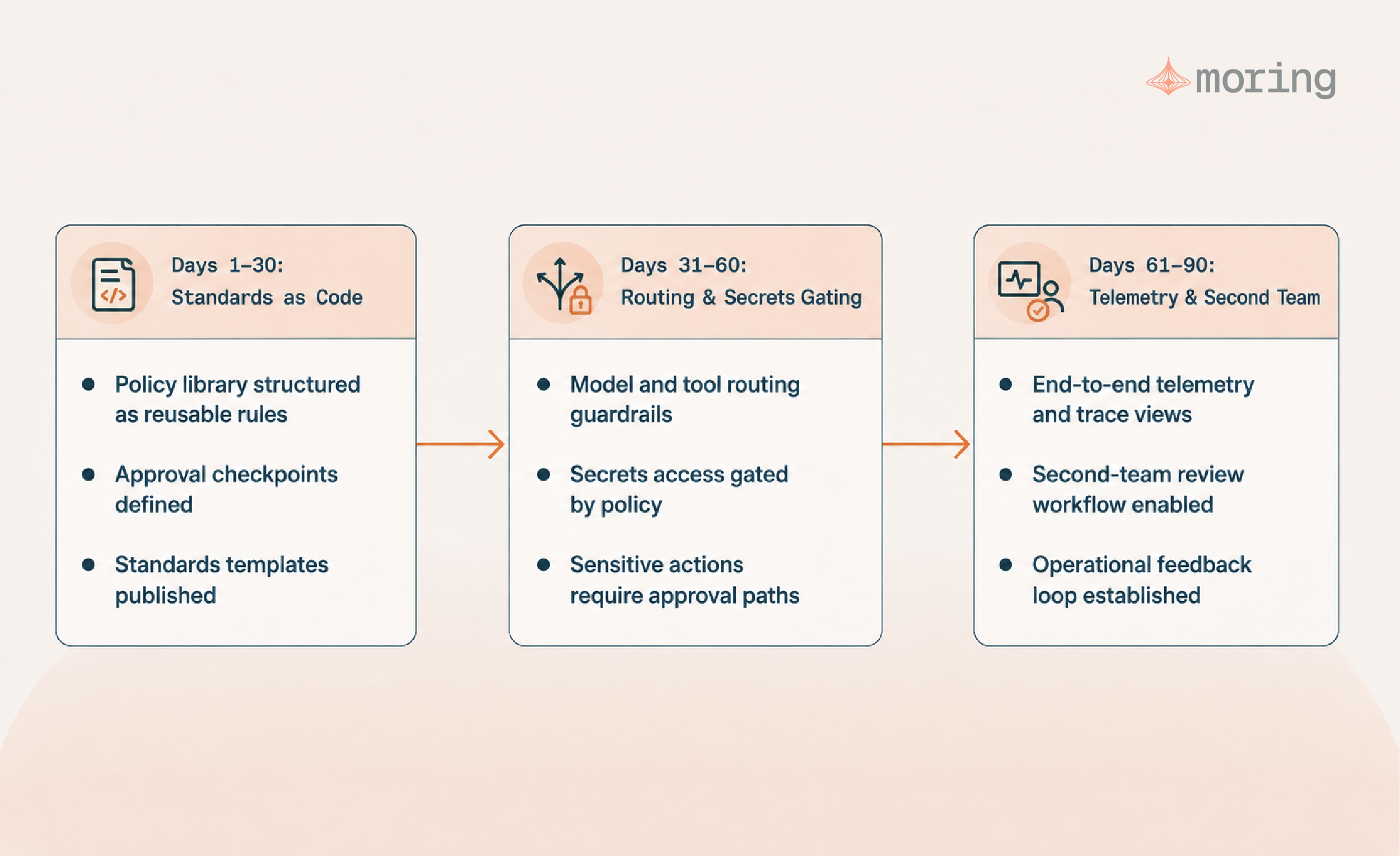
Figure 1. Three phases move from pilot-team standards to production-grade governance and multi-team scale.
Days 1–30: Standards as code
The first 30 days are an extraction exercise. Your pilot team already enforces standards: banned libraries, required test coverage, secret-handling rules, architectural constraints. These standards currently live in PR comments, Slack messages, and the institutional memory of senior engineers. Week one is a baseline audit. Sit with the pilot team and inventory every informal rule they follow. Do not try to make the list elegant. Make it complete. If a senior engineer says "we never use library X because it has a known RCE," write that down. If the team requires integration tests for any new API endpoint, write that down. The output is a single document that captures what the team actually does, not what a compliance handbook says they should do.
Weeks two and three translate that audit into agent-readable files. If you are using Claude Code, this means a `CLAUDE.md` file or equivalent agent instruction set that the tool reads at session start. If you are using a different agentic coding platform, the mechanism will differ but the principle is identical: move the top ten to fifteen rules from your audit into the context window the agent sees before it writes a single line of code. Do not attempt to be comprehensive. Start with the highest-impact constraints. If your team has an existing security guide, extract the top five items and add them to the agent context. Same for architecture standards, same for testing requirements. The goal is not to encode every possible rule; it is to encode the rules that prevent the most common classes of defect.
Week four adds session-level hooks. A pre-commit secret scanner that blocks any commit containing a pattern that looks like an API key. A hook that prevents direct commits to the main branch. A hook that requires a test file for any new HTTP endpoint. These are not new rules. They are the existing rules your senior engineers enforce manually, now enforced by the session itself. By day 30, your pilot team is running the same agent they used in the pilot, but the agent now reads a standards file at session start and triggers enforcement hooks before code leaves the developer's machine. You have not written a governance document. You have built governance that runs.
Days 31–60: Agent routing and secrets gating
The second 30 days add two control surfaces that make governance domain-aware. The first is classification and routing. Not every code change requires the same level of scrutiny. A UI layout tweak and a cryptographic key rotation are different request types that should trigger different handling. Weeks five and six build a routing layer that classifies incoming developer requests and dispatches them to specialist agents automatically. Security-sensitive changes (authentication logic, authorization checks, cryptographic operations) route to a security-reviewer agent that has deeper context on OWASP Top 10 mitigations and your organization's threat model. Infrastructure changes (Terraform files, Kubernetes manifests, CI/CD pipeline definitions) route to an infrastructure specialist that knows your cloud architecture and cost constraints. Data pipeline changes route to a data-engineering specialist that enforces schema versioning and PII handling rules.
This routing is not manual. The classification happens at session start based on the files the developer opens, the directory structure, and the stated intent of the session. If a developer says "I am adding a new OAuth flow," the router sees the words "OAuth" and "flow," checks the target directory, and dispatches to the security specialist before the first line of code is generated. The specialist agent has a different instruction set: it enforces stricter review, requires test coverage for edge cases, and flags any use of deprecated cryptographic libraries. When the session ends, the routing layer logs which specialist handled the request and what checks it applied.
Weeks seven and eight add secrets gating. The default behavior in most AI coding tools is to load the entire `.env` file into session context so the agent can reference connection strings, API keys, and service credentials when generating code. This is a credential-leak risk surface. A developer working on a React component does not need database credentials in their session context. A developer debugging a frontend layout does not need the production Stripe API key. Secrets gating requires each session to declare what it needs upfront. The session says "I am working on UI; I need no database credentials," and the gating layer loads only the environment variables required for that scope. If the developer later tries to access a gated secret, the session prompts for justification and logs the access. This single change closes the majority of AI-mediated credential exposure risk.
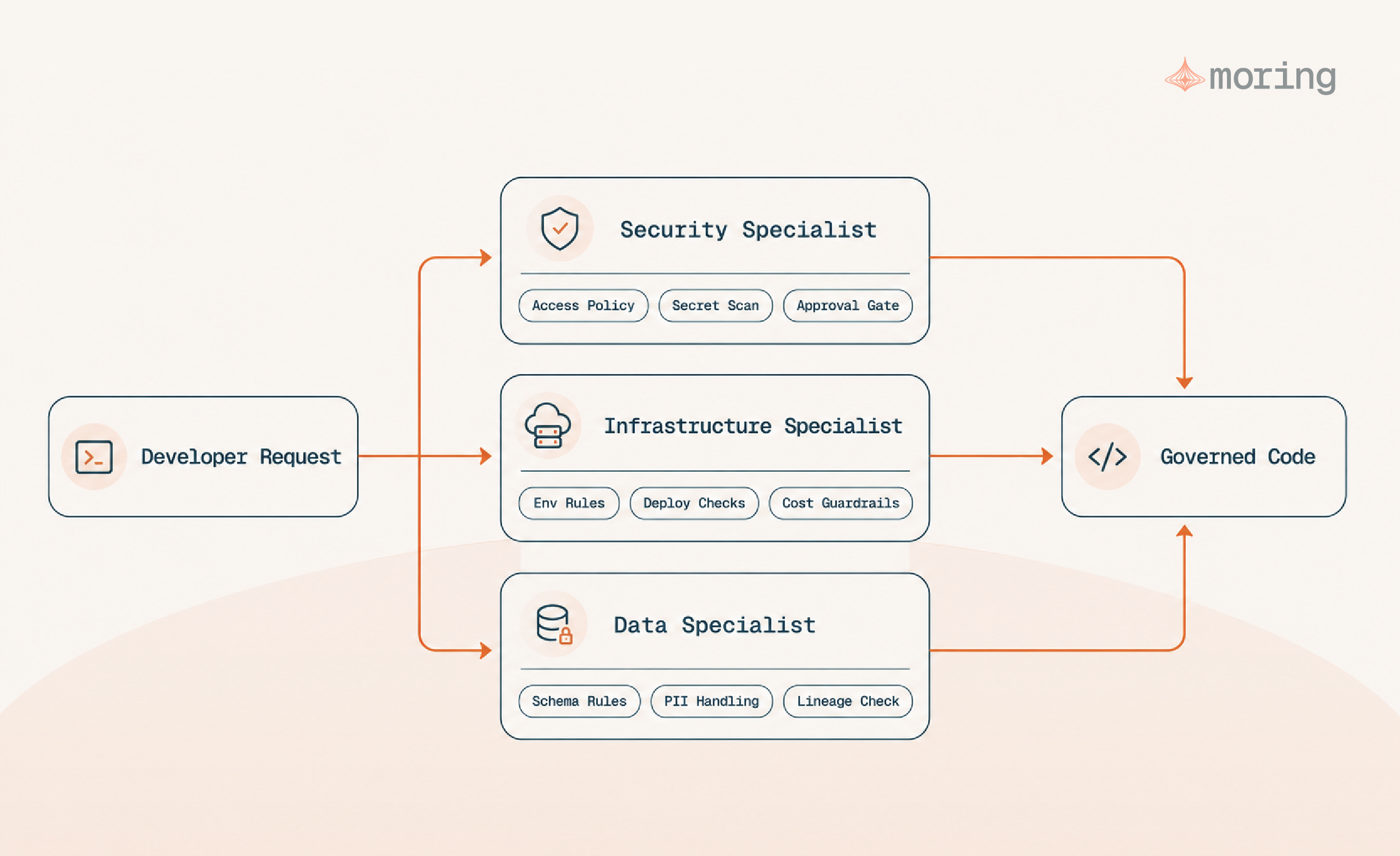
Figure 2. Request classification dispatches to specialist agents with domain-specific instruction sets and enforcement rules.
By day 60, your pilot team is working with automatic specialist routing and session-scoped credential gating. The standards you encoded in days 1–30 are now enforced by the right specialist depending on what the developer is doing, and secrets are loaded only when the session type justifies them.
Days 61–90: Telemetry and rollout to a second team
The final 30 days make governance durable and prove it is portable. Weeks nine and ten add audit telemetry. Every session, every agent dispatch, every tool execution, and every generated artifact must be captured to a log that your security and compliance teams can query. This is where "we deployed AI agent governance" becomes a claim you can defend to an auditor or a regulator. The telemetry layer records which standards file the session loaded, which specialist agent handled the request, which secrets were gated or accessed, and which session-level hooks fired. It does not record the full code diff (that would create an unmanageable data volume), but it records enough metadata to reconstruct what happened and why.
This telemetry feeds into your existing observability stack. If you run Datadog or Splunk, the agent telemetry should land in the same place your application logs land. If you are subject to SOC 2 or ISO 27001 audit, this log becomes the evidence that your AI coding tools operate under the same control framework as your other development infrastructure. The telemetry schema should include at minimum: session ID, developer identity, timestamp, request classification, specialist agent invoked, standards file version, secrets accessed, and any enforcement actions triggered (hook fired, commit blocked, manual review required).
Weeks eleven and twelve expand to a second team. This is the test of portability. The second team adopts the pilot team's configuration as a baseline and layers their own domain-specific standards on top without disturbing the baseline. If you built your days 1–60 work as a single flat file, the second team will break it. If you built it as a composable stack (base standards + domain overrides + team-specific rules), the second team can extend it without forking. The rollout process for the second team is: copy the base configuration, add their domain-specific rules to a separate override file, run a one-week shadow period where the agent generates suggestions but does not enforce, and then flip enforcement on.
During the shadow period, collect feedback. The second team will surface edge cases the pilot team never encountered. A mobile team may need different dependency management rules than a backend team. A data science team may need to access credentials the gating layer currently blocks. These are not failures; they are the expected output of expanding scope. The feedback loop is: second team surfaces an edge case, you decide whether it is a base-standard change (affects all teams) or a domain override (affects only this team), you update the appropriate file, and you redeploy. By day 90, you have two teams running under governed agent sessions, a telemetry stream that proves governance is operating, and a configuration architecture that can scale to ten teams without requiring a rewrite.
How does this plan differ from a compliance-first governance rollout?
This plan is orthogonal to, not a replacement for, the compliance-side AI governance work your Chief AI Officer or Chief Compliance Officer may already own. Regulated industries require a GRC platform that produces model inventories, risk assessments, and regulator-facing documentation. That work is non-optional. What this plan builds is the engineering control surface: the layer that makes the AI agent honor your standards at the keyboard, not the layer that documents those standards for an auditor. Both layers are legitimate. They solve different problems. A compliance-first rollout gives you a policy document and a model registry. An engineering-first rollout gives you session-level enforcement and domain-aware routing. You need both.
The integration point between the two layers is the telemetry stream. The audit logs this plan produces in days 61–90 become evidence artifacts for your compliance team. When an auditor asks "how do you ensure that AI-generated code follows your secure coding standards," the compliance team points to the telemetry that shows every session loaded the standards file, every security-sensitive request routed to the security specialist, and every credential access was gated and logged. The engineering team does not have to speak audit language, and the compliance team does not have to understand agent routing. The telemetry is the translation layer.
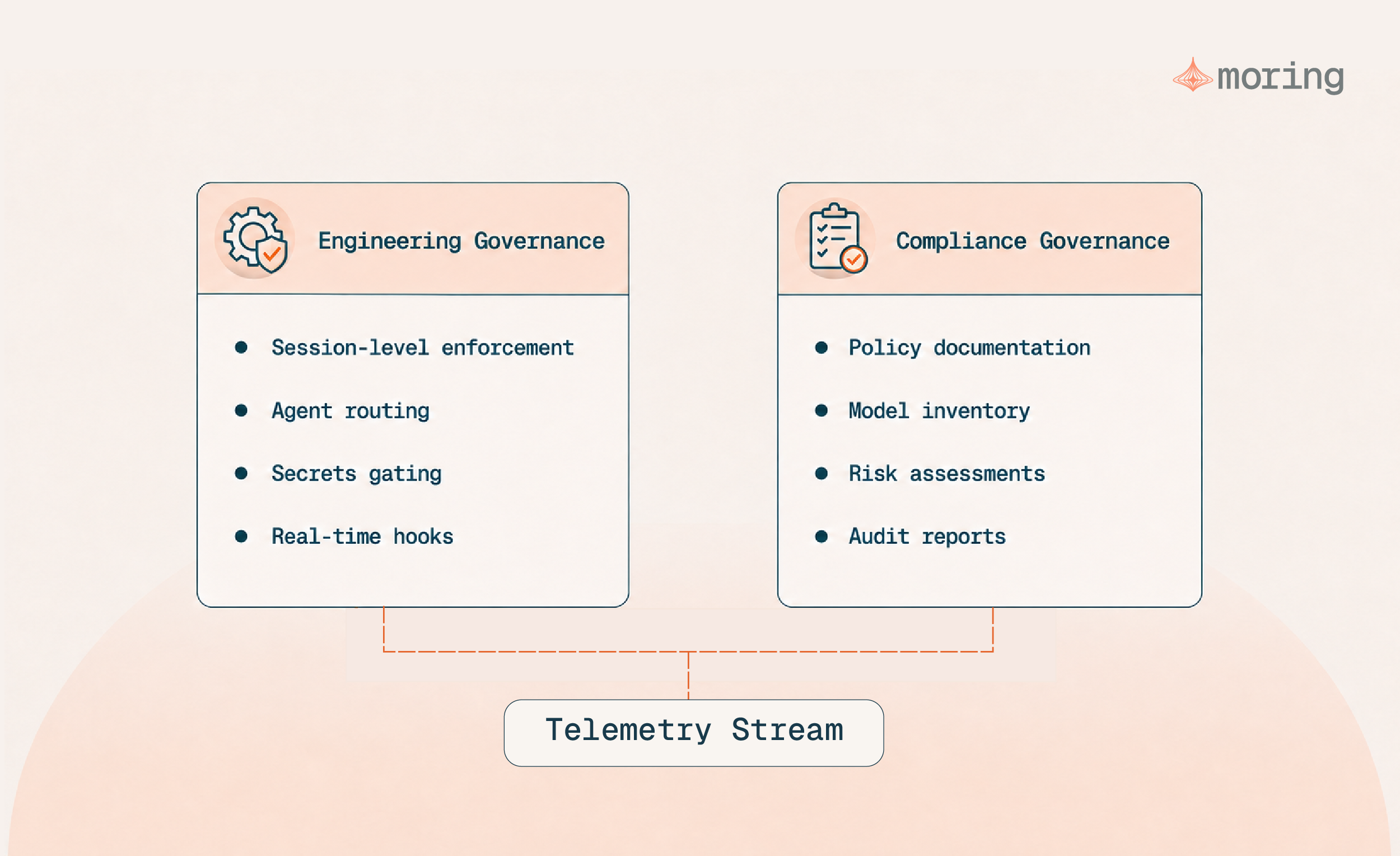
Figure 3. Both layers are required; telemetry is the integration surface between them.
What does success look like at day 90?
At the end of 90 days, you have two teams running AI agent sessions under production-grade governance. Every session loads a standards file that encodes your organization's architectural, security, and testing requirements. Every request is classified and routed to a specialist agent with domain-specific instruction sets. Secrets are gated by session type so that developers working on UI never see production database credentials. Every session, dispatch, and enforcement action is logged to a telemetry stream your security and compliance teams can query. The configuration is composable: new teams can adopt the base standards and layer domain-specific overrides without forking the entire stack.
Success does not mean you have rolled out to every team in the organization. Success means you have proven that governance can scale beyond the original pilot team without collapsing back into informal enforcement. The second team is the proof. If the second team adopts the configuration, runs a shadow period, flips enforcement on, and operates successfully for two weeks without escalating a governance-breaking edge case every day, the architecture works. You can now add a third team, a fourth team, and eventually a tenth team using the same expansion process: copy base configuration, add domain overrides, shadow period, enforce.
The alternative is what most organizations do: they run a successful pilot, declare that "AI agents are approved for use," and then watch adoption stall because no team wants to be the second team that has to re-negotiate every standard from scratch. This plan avoids that failure mode by making governance portable from day one.
Key takeaway
Moving AI agents from pilot to platform requires governance infrastructure, not just technical capability. A 90-day rollout plan builds that infrastructure in three phases: days 1–30 translate informal standards into agent-readable files and session hooks, days 31–60 add domain-aware routing and secrets gating, and days 61–90 layer in audit telemetry and prove portability by expanding to a second team. The plan is scoped narrowly—one pilot team to production-grade operation—because attempting a company-wide rollout on day one is the failure mode this plan avoids. By day 90, you have durable governance that survives team turnover and scales without re-negotiating every rule.
Frequently asked questions
What if our organization does not use Claude Code or an equivalent agentic tool yet?
The plan assumes you already have a working agent in pilot. If you are still evaluating tools, run a 30-day pilot first to validate that the tool produces acceptable code quality, then start this 90-day rollout plan. Attempting to choose a tool and build governance simultaneously will push the timeline past 90 days.
Can we skip the second-team expansion and roll out to everyone at once after day 60?
You can, but you will surface ten times as many edge cases simultaneously and lose the ability to iterate on the configuration before it is load-bearing for 200 developers. The second-team expansion is the test that proves your governance architecture is composable. Skipping it is a risk.
How does this plan interact with our existing AI governance policy document?
This plan builds the engineering control surface that enforces the policy. The policy document describes what should happen; the agent instruction files, routing layer, and secrets gating make it happen. If your policy says "all authentication code must be reviewed by a security specialist," this plan is how that review happens automatically at session time.
What if the pilot team resists having their informal standards formalized?
Resistance usually means the audit in week one surfaced disagreements the team had been avoiding. Resolve those disagreements before proceeding. If the team cannot agree on what their standards are, formalizing them will not work. The audit is a forcing function for alignment.
Do we need a dedicated AI governance platform to implement this plan?
Not for the first 90 days. The standards files, routing logic, and secrets gating can be built with scripting and session configuration in your existing agent tool. After day 90, as you scale to ten or twenty teams, a control-plane platform like Moring becomes valuable because it centralizes configuration management, telemetry aggregation, and policy inheritance across teams. But for two teams, you do not need it yet.
Book a 90-minute AICP diagnostic workshop with Moring to map your current agent usage, identify governance gaps, and adapt this rollout plan to your organization's specific constraints and tooling.
Sources and further reading
- https://fluid.ai/blogs/60-day-roadmap-agentic-ai-platform
- https://www.azilen.com/blog/agentic-ai-roadmap/
- https://narratize.com/blogs/90-day-ai-implementation-roadmap-for-new-product-development
- https://encephalon.net/blog/implementing-ai-governance-in-90-days/
- https://www.cloudflight.io/en/download/guide/your-90-day-plan-to-move-agentic-ai-into-production/
- https://basgcorp.com/blog/enterprise-ai-south-florida-businesses-adoption-guide/
- https://www.linkedin.com/pulse/90-day-enterprise-ai-strategy-week-rajesh-k-gupta-mkj4c
- https://www.metacto.com/blogs/ai-pilot-to-production-the-90-day-plan-for-mid-market-companies
- https://jetruby.com/blog/enterprise-ai-agents/
- https://www.getvocal.ai/blog/enterprise-saas-conversational-ai-scaling
- https://appstekcorp.com/blog/enterprise-ai-roadmap-agentic-era/