

Key takeaways
- A handback starts a second workflow. Design it with the same care as the agent’s own steps: states, owners, timers and an exit.
- Every handed-back item needs a named owning team and an assignment rule from the moment it arrives. A shared inbox is not an owner.
- The reviewer should see the request, what the agent did and did not do, why it stopped, the evidence and the proposed next step on one screen.
- An unclaimed item should escalate on a timer to a named role, and the system must not proceed with the consequential action until it is authorized.
- Before the agent resumes, it should recheck the current record and its current authority. Preparation done on Monday may not be true on Wednesday.
An agent can stop at exactly the right moment, explain itself clearly, and still waste the time it was meant to save. That happens when the handed-back item lands somewhere with no owner, no limit on how long it can wait, and no check that the agent’s preparation is still true when someone finally acts on it.
For example, suppose a broker asks a commercial lines servicing team to change the description of an insured location, effective from the start of the policy period. The servicing agent finds another change to the same location already recorded with a later effective date. It stops, as it should, and posts a handback to the team’s shared exceptions inbox: the request, the conflicting transaction, and a proposed comparison of the two.
Two days later the broker chases. A specialist opens the item for the first time and finds that a colleague processed a separate endorsement in the meantime. The agent’s comparison now describes a policy state that no longer exists, so the work starts again. (The scenario is illustrative.) Nothing was wrong with the handback. Nobody owned the item, nothing measured how long it had waited, and nothing checked whether the preparation was still valid.
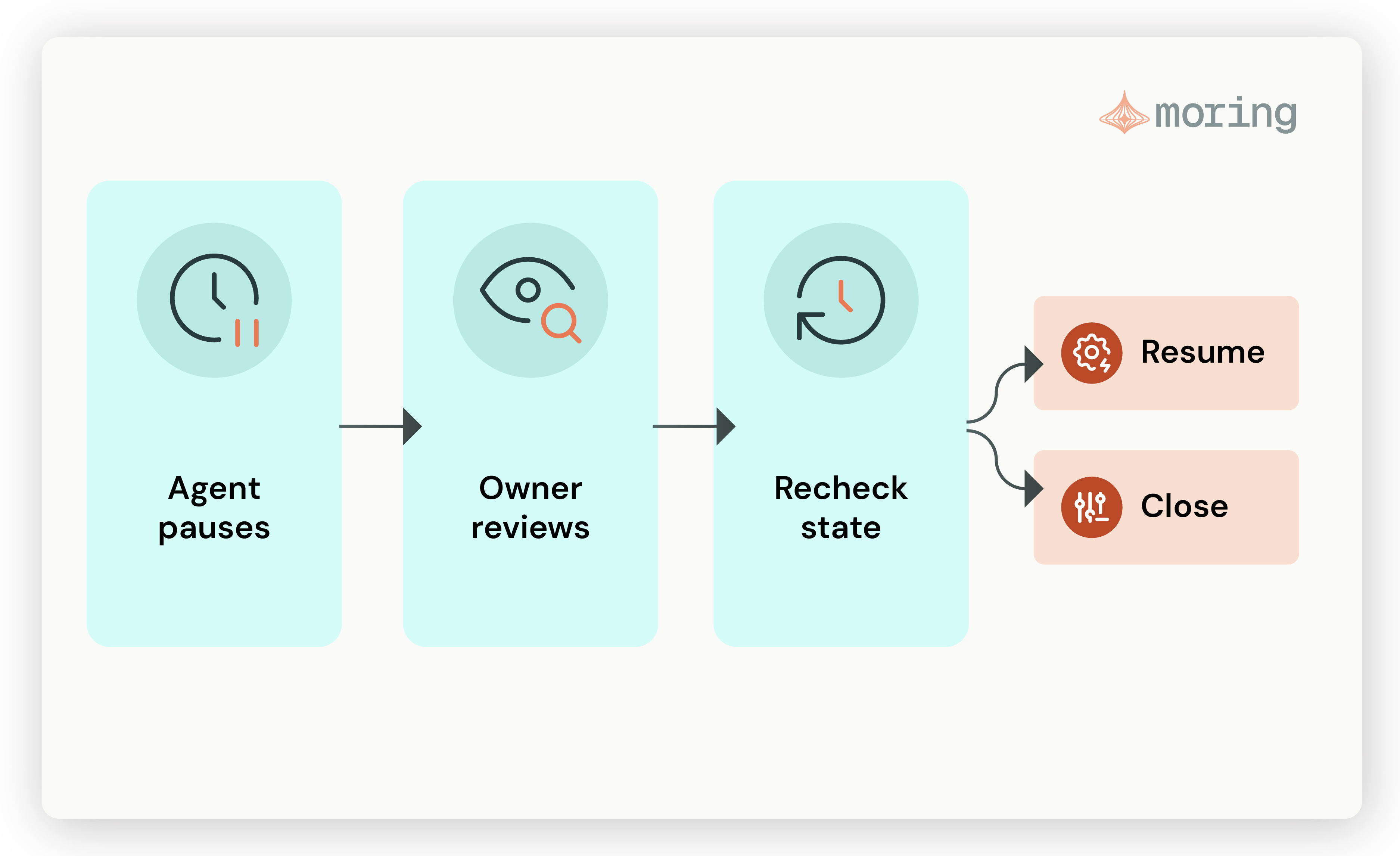
Handback continues through owner review and a state recheck before work resumes or closes.
The handback starts a second workflow
The moment an agent should stop deserves its own design work, and the conditions that should make an agent pause and hand back are worth getting right. But once the handback is sent, the operational cost moves to the people receiving it. If the queue has no structure, handed-back work either stalls or gets redone from scratch, and both erase the time the agent was meant to save.
The fix is to treat the queue as a small state machine. Each item moves through a fixed set of states, each state has someone allowed to move the item out of it, and each transition should record the change, its time and the responsible actor.
Five states, each with an owner and a record
Here is a starting model. Adapt the names to your operation, but keep the idea that every state answers “who has this, and what are they waiting for?”
| State | Who moves it out | What the move records |
|---|---|---|
| Received | Assignment rule or team lead | Arrival time, handback reason, owning team |
| Assigned | The named specialist | Who picked it up and when |
| Waiting on information | The specialist, when the answer arrives | What was asked, of whom, and when |
| Decided | The specialist | The decision, the evidence relied on, and who made it |
| Resumed or closed | The agent (after rechecks) or the specialist | Whether the agent continued, restarted, or a person finished the work |
Two details make this work in practice. First, “Waiting on information” should name what the item is waiting for. “Waiting on broker to confirm effective date” can be chased. “Pending” cannot. Second, an item can loop from “Waiting on information” back to “Assigned”, but it should never drop back to “Received” without a record, or ownership quietly disappears.
What the reviewer needs on one screen
When a specialist opens an item, they should not have to reconstruct the case from logs. The AWS Well-Architected Agentic AI Lens guidance on human review of agent actions names the anti-pattern directly: giving reviewers only the proposed action, without the reasoning, data sources or potential consequences, turns review into a formality.
For a servicing handback, that means one view with:
- The original request, in the requester’s own words, with the date it arrived.
- What the agent completed, and what it deliberately did not attempt.
- The specific reason it stopped, such as “a later transaction carries an earlier effective date”.
- The evidence it relied on, each item linked to its source record.
- The action it proposes, if it proposes one.
- The time the agent took its snapshot of the policy record.
That last item is easy to leave out and matters most. In policy servicing, an approval belongs to a specific policy state, so the reviewer needs to know which state the preparation describes.
Timers: an unclaimed item needs somewhere to go
The same AWS guidance lists a second anti-pattern: approval workflows with no timeout or escalation path, so work stalls when reviewers are unavailable. It describes timeouts that route the item to a secondary reviewer or a manager, or fall back to a safe default, which is usually blocking the operation.
For an exception queue, set two timers. A claim timer starts when the item arrives; if nobody picks it up in time, it escalates to a named role, such as the team lead on shift. A decision timer starts at assignment and reflects your own service standard for that type of request. When either timer fires, the item gets louder. It does not get approved.
Log who picked up each item and when. The AWS guidance recommends recording reviewer identity, timestamps, the operation under review, the decision and any escalation. Those records let you see later whether the timers are set sensibly or whether one team is quietly absorbing everyone’s exceptions.
Resuming without acting on a stale picture
Once a person resolves the exception, there are three ways forward:
- The agent continues from its saved state.
- The agent restarts the request from the beginning.
- The person finishes the work themselves.
Continuing is fastest, but only if the saved state is still true. Before the agent acts, it should re-read the current record and validate all state relevant to the proposed action against its saved snapshot. If anything relevant changed, the item goes back to “Assigned” with a note explaining what moved. It should also recheck its authority at that moment, using the identity and permission design for the tool calls it is about to make, and confirm that the approval remains valid for the current action and state, rather than assuming an approval from two days ago still covers the action.
Restarting suits cases where the person’s decision changed the request itself. Finishing by hand suits cases where the remaining work is a judgment call, or so small that handing it back to the agent adds a step rather than removing one.
Measure the queue as well as the agent
Agent dashboards tend to report what the agent did. The queue tells you what it cost everyone else. Useful measures include:
- Time from arrival to assignment.
- Time from assignment to decision.
- The share of items where the agent’s preparation was used, compared with items redone manually.
- Handback reasons, grouped into categories.
- Items reopened after closure.
These are suggested measures, not benchmarks, and the right targets depend on your service standards. The value is in the trends. If one handback reason dominates, that is a change to make in the agent, its data or the process. The NIST AI Risk Management Framework, a voluntary framework, describes post-deployment monitoring that captures input from users and other relevant people, along with appeal, override and change management (MANAGE 4.1). Handback reasons are exactly that kind of input. Route them to the person accountable for the agent, not only to the queue.
The same endorsement, with the queue in place
Here is the fictional example again, simplified, moving through the five states.
- Received. The agent prepares the location change, finds the out-of-sequence conflict and hands back. The record shows the reason, the conflicting transaction and the snapshot time. The assignment rule routes it to the commercial servicing team.
- Assigned. A specialist claims it within the claim timer. The record shows who and when.
- Waiting on information. The specialist asks the broker which effective date they intend. The record names the question and the broker.
- Decided. The broker confirms. The specialist decides to apply the change from the confirmed date and records the evidence.
- Resumed. The agent rechecks the policy record, finds no new transactions since its snapshot, and prepares the final change. The specialist reviews it, authorizes the transaction, and the system commits it. The item closes with both actions recorded.
If step 5 had found a new transaction, the item would have returned to the specialist rather than proceeding.
Exception queue checklist
- Every handed-back item has a named owning team and a default assignment rule.
- Each queue state is defined, along with who can move an item out of it.
- “Waiting” states name what the item is waiting for and who was asked.
- The reviewer sees the request, completed actions, the stop reason, linked evidence, the proposed action and the snapshot time on one screen.
- Unclaimed items escalate on a timer to a named role, and no timer ever approves an action.
- The agent resumes only after rechecking the current record and its current authority.
- Handback reasons are categorized so repeat causes reach the agent’s owner.
- Closing an item records who decided, what was done, and whether the agent’s preparation was used.
Also read: What to retain when an AI agent supports a decision
Sources
- AWS Well-Architected Framework, Agentic AI Lens, AGENTSEC04-BP02: Human-in-the-loop for critical decisions. Vendor guidance on reviewer context, timeouts, escalation paths and approval logging.
- NIST AI RMF Core. Voluntary framework. MANAGE 4.1 on post-deployment monitoring. Citing it does not imply this design meets any framework or requirement.
The queue states, timers and measures above are Moring’s recommendations. The servicing scenario is illustrative.
Frequently asked questions
What is an exception queue for AI agents?
Should an agent resume a case after a person resolves the exception?
What should an exception queue measure?
Governing Autonomous AI Agents in Production
Moring provides the runtime control layer, identity verification, human-in-the-loop approvals, and audit records needed to deploy production-grade AI agents safely.
About the author

Arya SharanDirector of Product Marketing & GTM, Moring AIChennai
Owns product marketing and go-to-market at Moring AI across positioning, demand and enablement. Works with regulated buyers on how governed AI agents are scoped, evaluated and bought. Writes about the operating questions that decide whether an agent reaches production.
LinkedIn profile