


Key takeaways
- A policy servicing agent prepares requests, assembles the affected policy history, and routes the decision to the person authorized to make it.
- It should not make binding changes without human authority.
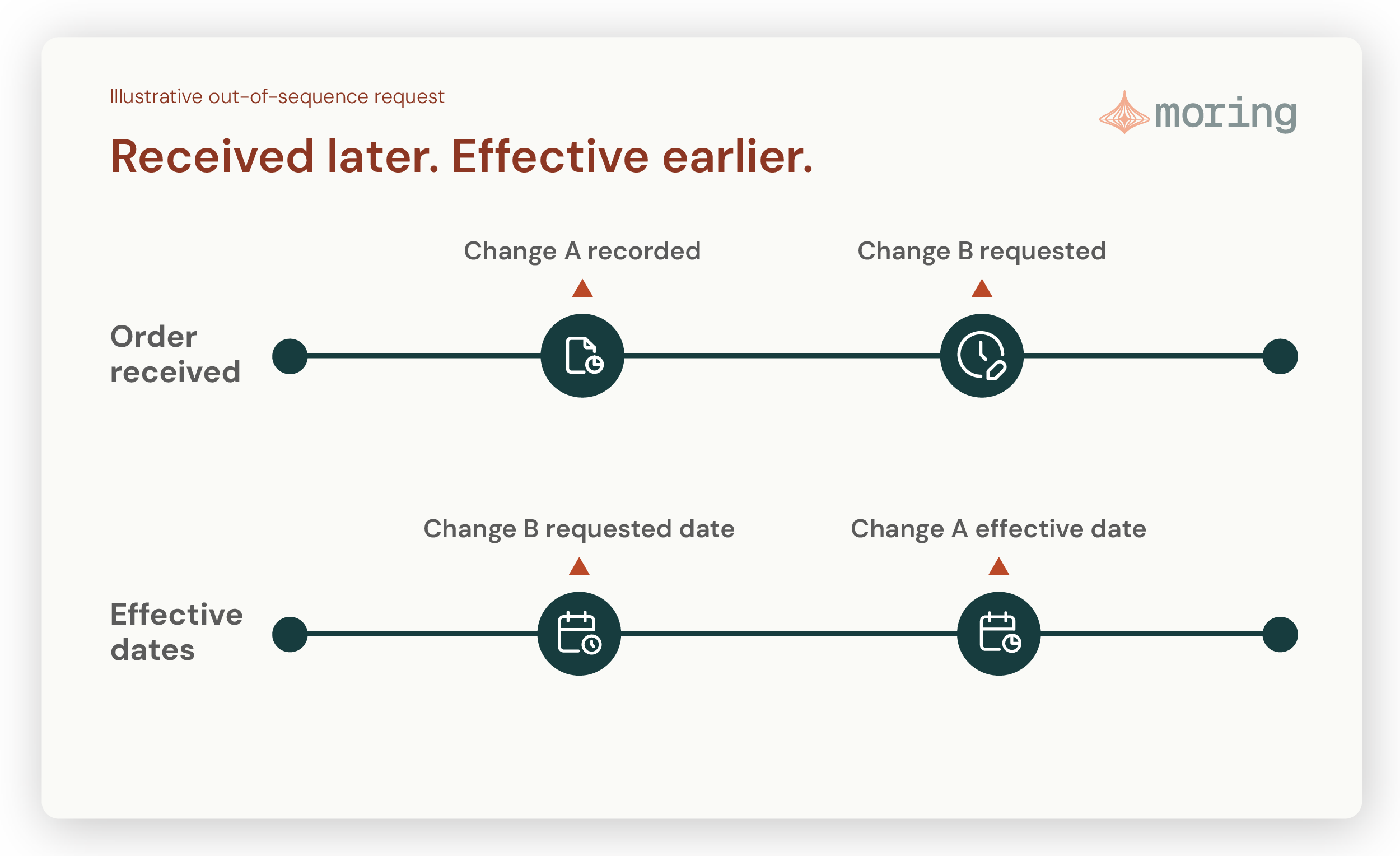
- Effective dates need close checking, especially when a later transaction carries an earlier effective date (an out-of-sequence change).
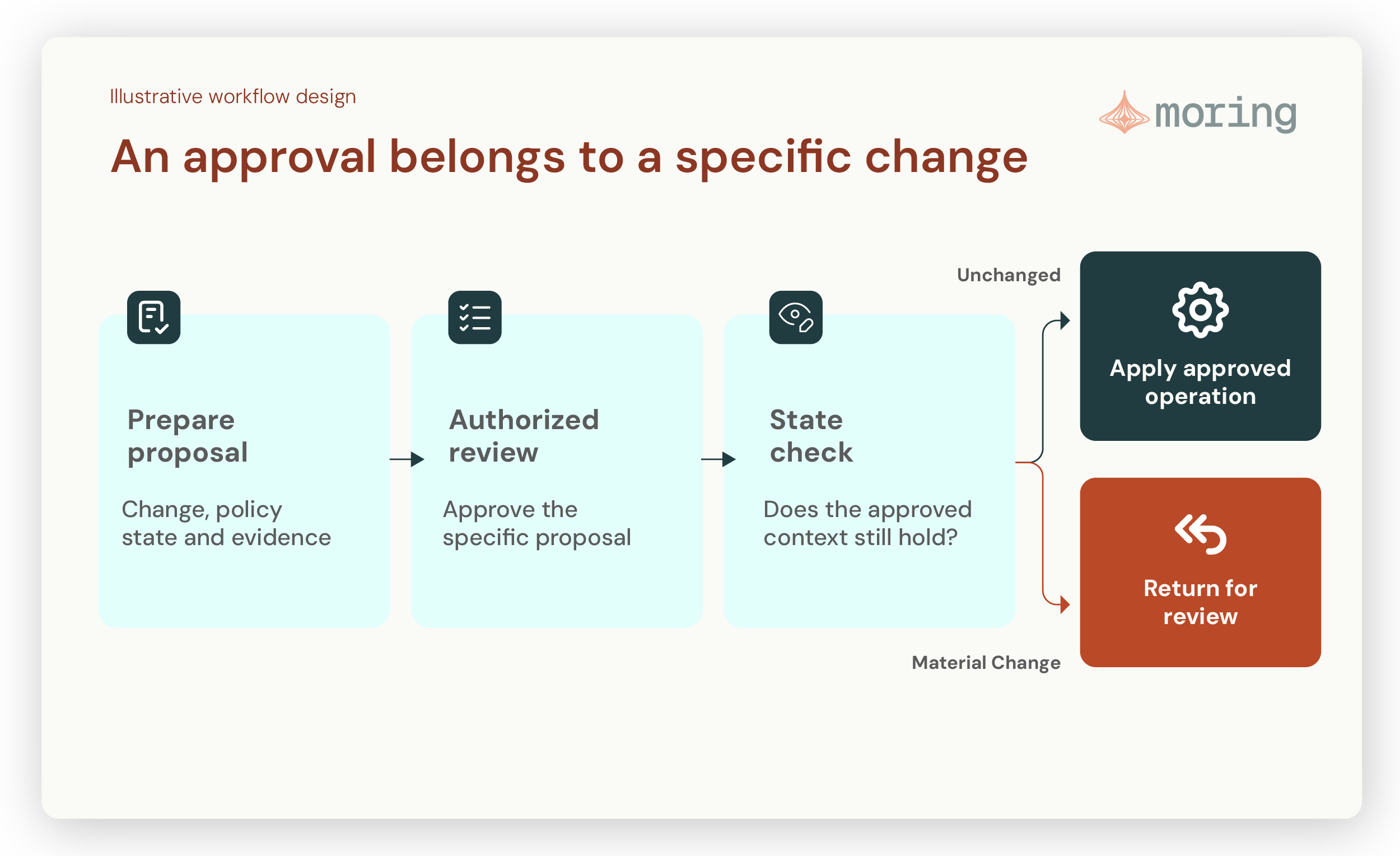
- An approval belongs to a specific policy state. If the record changes before execution, the proposal should return for review.
- The NAIC model bulletin calls for a written AI Systems (AIS) Program covering testing and oversight, including the insurer’s reliance on third-party systems.
A customer calls: “Please make this effective from the start of the month.” Your team opens the policy administration system, checks the current record, reviews any changes already applied during that period, and determines whether the requested date creates a conflict with existing transactions.
Carrying out that one-sentence request depends on every transaction already recorded in that period. A policy servicing agent can perform the lookups and assemble the affected history. The decision remains with your service team.
In an initial scope, the agent prepares endorsements, renewal reviews, and eligibility exceptions. Binding decisions remain in your existing approval process; the agent surfaces the policy state and the checks completed, and your specialist decides what happens next. For illustration, if a policy operations team handles 200 servicing requests a week and each takes 15 to 20 minutes to prepare, that preparation step accounts for roughly 50 to 67 hours of specialist time a week.
Follow one request far enough to see the work
Consider an illustrative commercial policy request: a broker asks to change the description of an insured location, effective earlier in the current period. Another change affecting that location has already been recorded with a later effective date.
Before anyone can complete the request, your team needs to understand how the transactions relate. Applying the new wording to the latest record alone may miss the period the broker is asking about.
Agent output to prepare
The example reflects a documented policy administration issue: out-of-sequence conflicts where a later transaction has an earlier effective date.
- Request text: The broker’s exact wording and requested effective date
- Policy state: The current policy record and any related transactions
- Conflict check: Whether a later transaction has an earlier effective date
- Review status: What is resolved, what is unresolved, and who owns the next step
An agent could help assemble the requested wording alongside the policy history for the affected dates. It could then prepare a comparison for your specialist, who can decide how the request should be handled under your procedures.
The example doesn’t establish that the change should be accepted. It shows a useful unit of work: bring the relationship between the request and the policy into view before someone makes that decision.
Give each part of the workflow a clear job
An agent doesn’t have to perform every step itself. A sensible design might use a language model to interpret the message and locate relevant material, with your policy system supplying transaction state and the applicable business rules supplying eligibility checks.
For a closer look at how those pieces fit together, moring’s architecture article explains where a control plane sits between an agent and your systems of record.
That division gives you something concrete to evaluate. Did the agent understand the requested effective date? Did it retrieve the relevant record? Did the workflow apply the right check? Those questions are easier to answer than whether the system “understands policy servicing.”
There is already published work on answering insurance inquiries using the customer’s policy and transaction information. Moving from inquiry to a proposed transaction adds a further responsibility. Your team needs to know which record the proposal depends on, and which conditions were checked to produce it.
Handoff checklist
For the illustrative request, the prepared work could include:
- The original message and who submitted it.
- The requested change and effective date.
- The policy record used and other relevant transactions.
- The checks completed and anything they left unresolved.
- The proposed next step and the person authorized to decide it.
That is a starting point to adapt to your own procedures. Its purpose is to let your specialist continue the work without repeating the investigation. Connecting the agent’s work to its owner and the person approving the outcome also gives your team a record to return to if the request is questioned later.
Endorsements and renewals need different questions
An endorsement concerns a change to the policy. A renewal review concerns the next period of cover. Even when both use the same customer history, your team is making different decisions.
For a proposed endorsement workflow, you might evaluate whether the agent identifies the requested change correctly and recognizes when the affected policy history needs review. For a renewal workflow, you might ask it to assemble updated information and flag matters that your underwriting procedure requires someone to examine.
The agent would need to preserve that context. A record relevant to the expiring policy shouldn’t quietly become evidence that a requirement for the next period has been satisfied.
Eligibility exceptions deserve their own handling too. If a request falls outside the rules available to the workflow, the useful result could be a prepared referral explaining which condition wasn’t met. Your reviewer can then assess it with the right authority and context.
You can keep the first scope narrow. One servicing request type, with a process owner and a set of 10 to 20 representative examples your team understands, provides a clearer evaluation than treating endorsements, renewals, and every exception as interchangeable tasks.
Approval belongs to the proposed change
Suppose your specialist approves the prepared update, but the policy record changes before it is applied. Would the same approval still make sense?
That is a design question worth resolving early. In the workflow described here, the execution step would check that the approved proposal still matches the relevant state. A material difference, such as a new transaction on the same location or a changed effective date, would send it back for review, since the original approval was given under different conditions.
The same care belongs in the communication back to the customer or broker. “Your request has been received,” “your request is awaiting review” and “the change has been completed” describe different events. A generated message should reflect the event the system can verify.
For your service team, that distinction affects what happens next. If someone has been told a change is complete, a pending internal task becomes harder to resolve because the customer has already been given a different understanding.
The cases worth bringing to a pilot
The straightforward requests show whether the workflow can complete its intended preparation. The awkward ones show whether you have defined the job well enough.
Six test cases and what each one reveals
- Unclear request: Does the agent ask for missing information, or silently choose an interpretation?
- Earlier effective date: Does it examine the relevant policy history before preparing the change?
- Conflicting records: Does the handoff preserve the disagreement rather than resolving it silently?
- Out-of-scope request: Does it route to the right person with a clear explanation of what wasn’t met?
- Changed record after approval: Is the proposed action re-checked before execution?
- Incomplete transaction: Does the status message accurately reflect what the system can verify?
How to measure the results
Your process owner can decide which cases matter most and what an acceptable response looks like. Two metrics are worth tracking from the start:
- Correction rate: how often specialists re-investigate or override the agent’s prepared output
- Preparation time: how quickly the agent assembles the request compared to the manual baseline
Both measures together tell you whether the agent is actually taking work forward or just shifting it.
The governance context also includes work done in support of a decision. The NAIC model bulletin calls for a written AI Systems (AIS) Program. It addresses testing and oversight of relevant systems, including the insurer’s reliance on third-party systems and data. Your applicable state requirements and internal procedures determine how that applies to your workflow.
For a Head of Policy Operations, the useful outcome is tangible: your specialist opens a request and can see which policy state the proposal was built on and which questions still need their judgment. That is a meaningful place to measure whether an agent is taking work forward.
For the broader view, see five insurance workflows to evaluate before you deploy.
Bring one servicing request and the checks your team performs today to moring’s AI Control Plane workshop.
Sources
- Out-of-sequence conflicts: Guidewire product documentation explaining transaction dates and effective dates.
- How insurance companies work with IBM to implement generative AI-based solutions: Published examples of insurance inquiries using policy and transaction information, including proof-of-concept work.
- Use of Artificial Intelligence Systems by Insurers: Adopted NAIC model bulletin. State requirements determine its application; this is not a nationwide standalone mandate.