

Agentic AIOps: who governs the ops agents?
AIOps platforms now deploy autonomous agents that restart services, reroute traffic, and roll back deployments without human approval. These are operations tasks that DevOps and SRE teams traditionally performed by hand: scaling a Kubernetes cluster when CPU spikes, terminating a misbehaving container, switching traffic to a healthy region during an outage, reverting a bad deployment. The agents execute these actions in seconds. The open questions are who audits their decisions, who owns liability when an agent causes an outage, and how you prove to a regulator that the agent acted within policy. Most AIOps vendors treat governance as an afterthought. Enterprises need a control plane before the first agent takes production action.
What is agentic AIOps?
Agentic AIOps means AI systems that observe telemetry, diagnose incidents, and execute remediation steps autonomously. Traditional AIOps aggregated logs, surfaced anomalies, and recommended actions for human operators to review and execute. Agentic systems close the loop: they detect a memory leak, identify the offending pod, and terminate it in seconds. No ticket. No approval queue. The agent acts.
This changes how operations work. The impact on incident-resolution time depends on the workflow and should be measured against a baseline. Routine remediation can require less on-call intervention when the action is approved in advance and bounded by policy. Infrastructure can handle more recovery steps automatically, while consequential actions remain reviewable. But autonomy introduces a new class of risk. An agent with AWS credentials to scale down a cluster can also scale down the wrong cluster. When that happens, you face a scramble to understand what went wrong. The agent’s reasoning lives in sparse logs that were never designed for human review, let alone audit. You will reconstruct the decision chain from fragments, and the story you piece together can fall short for your auditor and your executive team.
Why did the governance gap appear now?
Three forces converged in the past eighteen months. Foundation models became capable enough to interpret unstructured runbooks and API documentation, so vendors could ship agents that read Terraform manifests and Kubernetes configs without custom training. Enterprises had adopted enough baseline AIOps tooling that adding an autonomous layer felt like a small step. And cost pressure plus talent shortages made the promise of self-healing infrastructure irresistible to platform teams already stretched thin.
The vendors moved fast. Governance moved slowly. Most AIOps platforms log agent actions as generic API calls in the same stream as human operator commands. There is no native distinction between “agent restarted pod” and “engineer restarted pod.” No policy engine that says “agent restarts pods in staging but must page a human in production.” No audit trail that captures the reasoning chain the agent followed. When an auditor asks why this system made that decision, the answer is often a JSON blob and a shrug.
Regulatory frameworks raise the stakes. The EU AI Act classifies certain autonomous infrastructure systems as high-risk and mandates human oversight and technical documentation. DORA requires financial institutions to maintain detailed logs of all automated changes to critical systems. SOC 2 auditors now ask pointed questions about non-human actors with production access. The traditional AIOps model assumed humans remained in the loop. That assumption no longer holds.
Which governance questions must every agentic deployment answer?
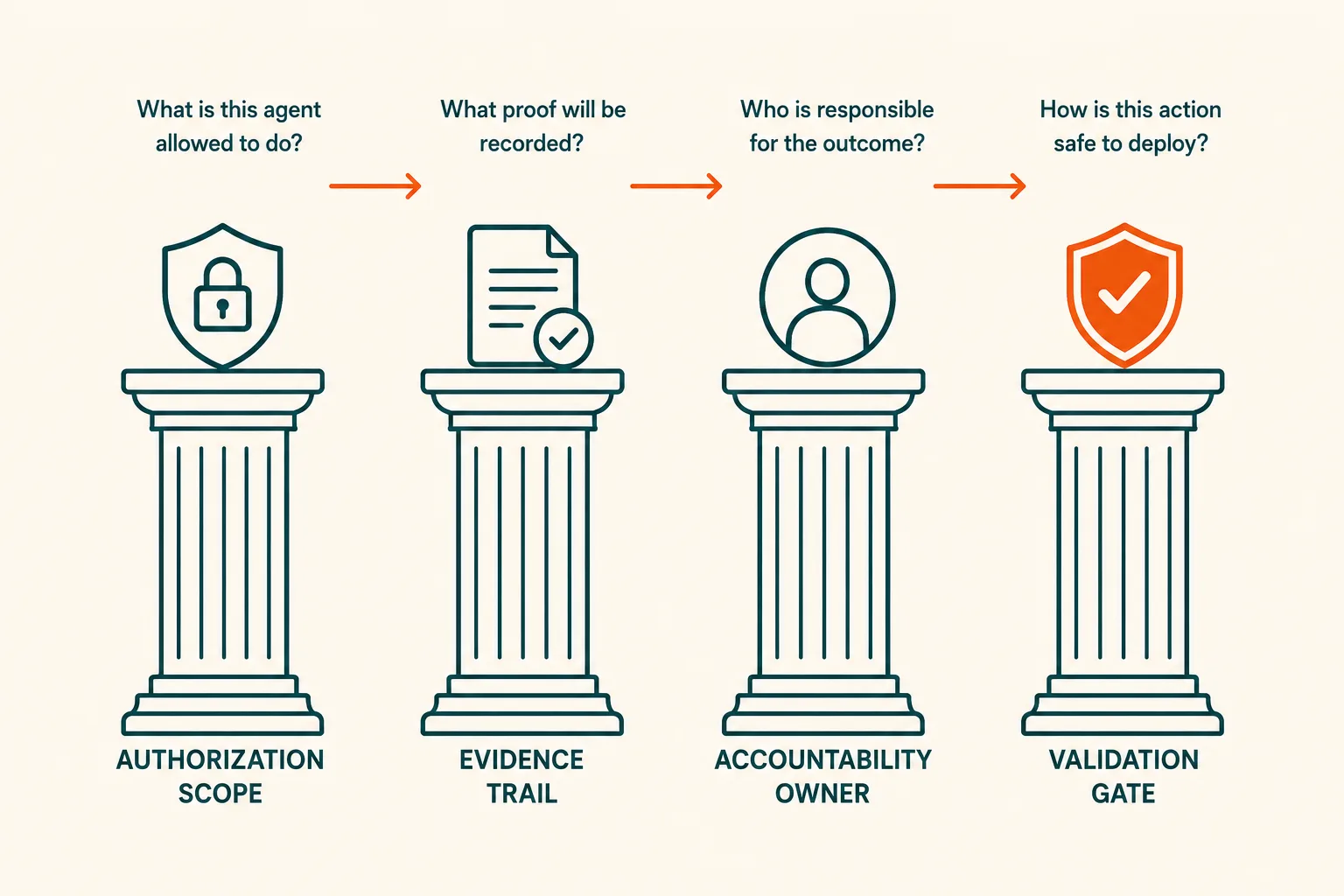
Before an autonomous agent touches production, you need defensible answers to four questions. These apply whether you run a proprietary vendor agent or an open-source tool wrapped in LangChain.
What is the agent authorized to do, and how is that scope enforced? An authorization policy must be explicit, versioned, and separate from the agent’s code. “The agent can read all metrics” is not enough. You need: “Agent X is authorized to execute actions in namespace Y when severity exceeds threshold Z, subject to approval if the action affects more than N resources.” This is role-based access control extended to non-human actors. The policy must be machine-readable and enforceable at runtime, not a paragraph in a wiki.
What evidence trail does the agent produce? The trail must include the input observations, the reasoning steps, the policy check, the action taken, and the outcome. A line in a syslog that says “pod restarted” is not evidence. A structured record that says “Agent A observed memory utilization 94% for 120 seconds, matched pattern B, checked policy C, executed action D, result E” is evidence. The difference matters in SOC 2 audits, incident retrospectives, and regulatory examinations. The trail should be protected against unauthorised alteration and available for review or export.
Who is accountable when the agent causes harm? Liability does not disappear because a machine acted. You need a defined escalation path and a human who owns the agent’s scope. If the agent misconfigures a load balancer and causes a two-hour outage, someone must be able to explain what guardrails were in place and why they did not prevent the action. “The model hallucinated” is not an acceptable answer to your board, your customers, or your regulator. Accountability requires a map from every agent to a responsible owner.
How do you test and validate the agent before it acts in production? Agents trained or fine-tuned on synthetic runbooks can behave unpredictably when they encounter novel failure modes. You need a sandbox environment where the agent proposes actions against real telemetry but executes them only in an isolated replica of production. The validation gate checks whether the agent followed policy and produced a legible reasoning chain. Whether it also fixed the issue comes second. Validation must happen before the agent receives production credentials.
How do enterprises govern agentic AIOps today, and where does each approach break?
Most organizations adopt one of three patterns. Each works until it does not.
Pattern one: treat the agent as a privileged service account. The agent gets AWS IAM credentials or Kubernetes RBAC roles identical to a senior engineer. Authorization is binary. Either the agent can act or it cannot, with no nuance for severity, blast radius, or approval thresholds. This pattern breaks the moment the agent makes a mistake, because the blast radius equals the agent’s maximum privilege. You cannot explain to an auditor why a service account had delete permissions on the production database. The answer “we trusted the agent” will satisfy nobody after an incident.
Pattern two: log everything and hope. The platform writes agent actions to the same observability backend that stores application logs. When something goes wrong, the SRE team greps for the agent’s identifier and reconstructs what happened. This pattern breaks under audit. The logs lack tamper protection, they lack compliance structure, and nothing links them to the policy that authorized the action. A regulator will ask how you know these logs are complete. You will not have a good answer. Logs written by the same system that took the action carry no independent evidentiary weight.
Pattern three: humans in the loop for every action. The agent proposes a remediation and waits for a Slack approval or a PagerDuty acknowledgment before proceeding. This pattern defeats the purpose of autonomy. If a human must approve every action, you have built an expensive recommendation engine and given up the speed you were paying for. The agent’s value collapses when the on-call engineer is asleep or ignores the notification. You still pay for the agent’s compute and the human’s time.
None of these patterns implement the four governance questions as first-class requirements. They are retrofits, and they show their seams under pressure. The traditional AIOps architecture was designed for systems that recommend. Execution was always assumed to be a human’s job.
What is the control-plane approach?
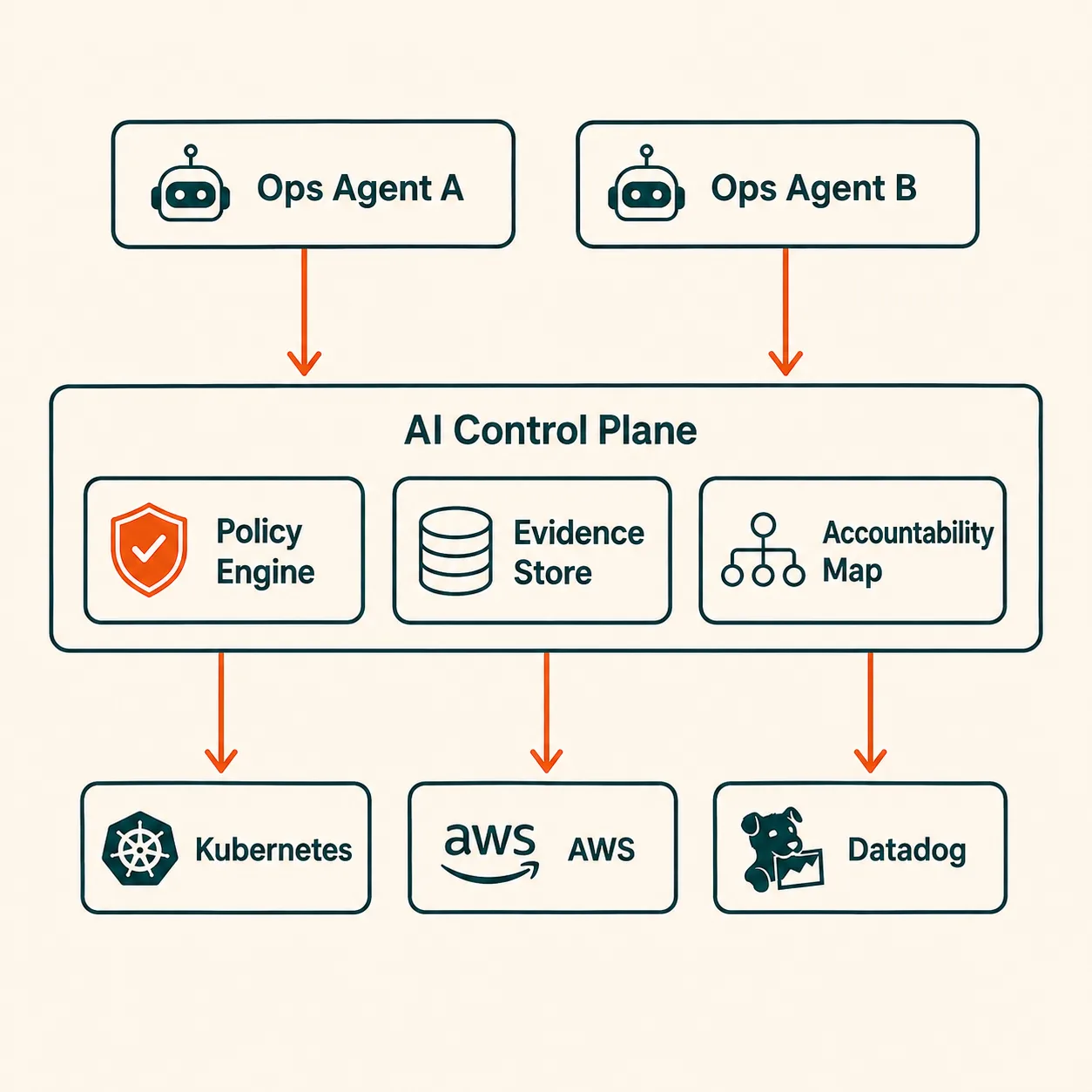
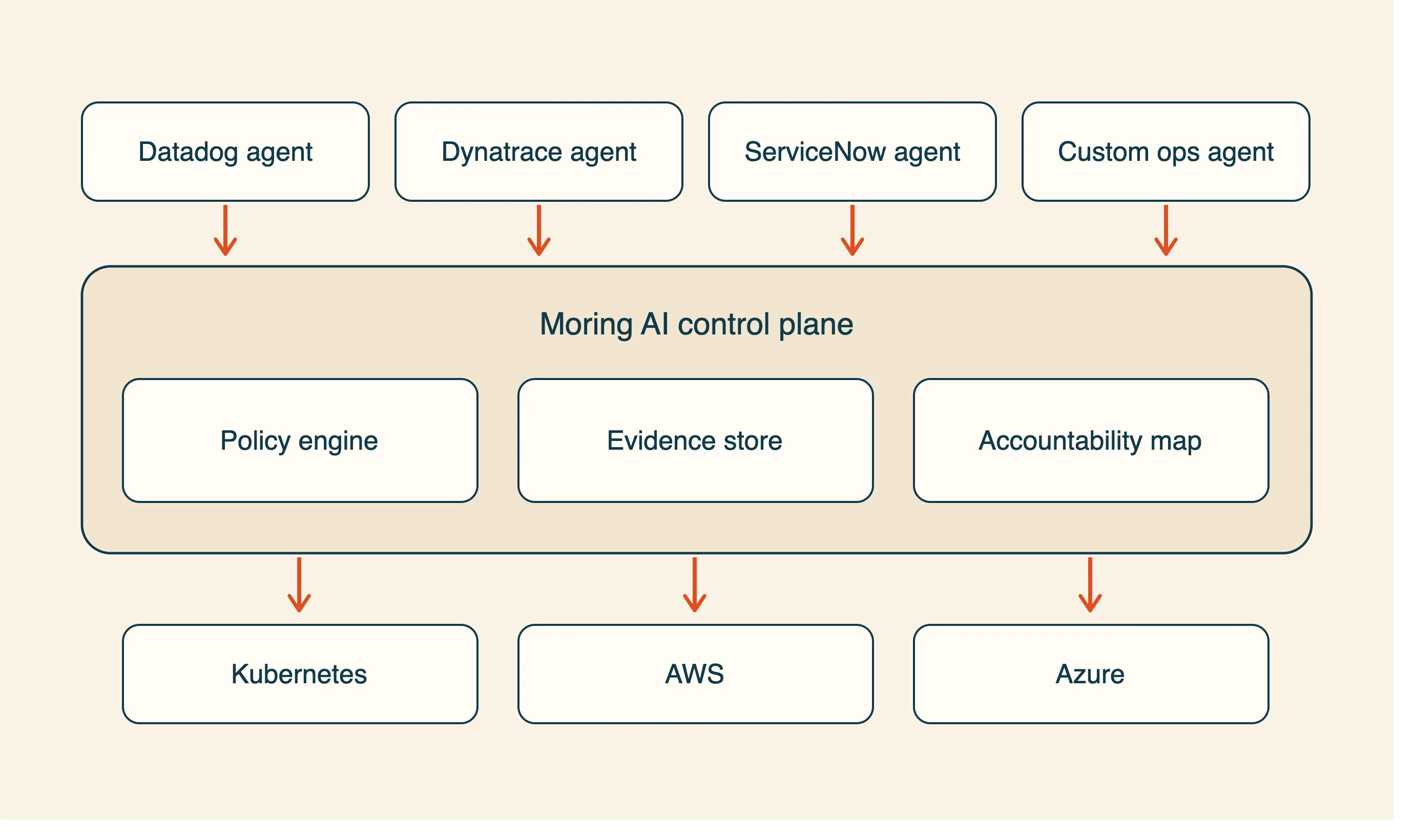
The durable solution is a control plane that sits between the agent and the infrastructure it acts upon. The control plane lives outside the AIOps platform: a separate governance layer that enforces policy, logs evidence, and manages accountability for all autonomous systems, ops agents included.
The architecture has three components. First, a policy engine that evaluates every proposed agent action against a versioned ruleset before the action executes. The rules are declarative: “Agent X is authorized to restart pods in namespace Y if memory utilization exceeds 90% for 5 minutes AND fewer than 10 pods are affected AND no deployment is in progress.” The policy is code, stored in version control, reviewed like any other infrastructure change. The engine returns a binary decision: approved or denied. No ambiguity.
Second, an evidence store captures a structured record of each agent decision. The record includes the input telemetry, available reasoning context, policy result, action and outcome. It should be protected against unauthorised alteration and use a documented schema so the team can review what happened without reconstructing the decision from separate logs.
Third, a human accountability map that links every agent to an owner, an escalation path, and a scope review cadence. When the agent acts, the control plane notifies the owner asynchronously. When the agent proposes an action outside its scope, the control plane pages the owner synchronously. The map ensures that no agent is orphaned and no action is unattributable.
This architecture applies to any autonomous system. The same control plane can govern coding assistants that commit to repositories, customer-service bots that issue refunds, or data agents that modify schemas. The pattern is reusable because the governance requirements stay consistent across domains: explicit authorization, structured evidence, human accountability, and validation before production access.
How does a governed auto-scaling agent work in practice?
Consider an AIOps agent that monitors CPU utilization and scales Kubernetes deployments. Without a control plane, the agent has direct access to the Kubernetes API and can scale any deployment in any namespace. With a control plane, the deployment looks different.
The platform team writes a policy: “Agent ‘autoscaler-prod’ is authorized to increase replica count for deployments in namespace ‘web-tier’ by up to 50% if CPU utilization exceeds 80% for 10 minutes AND the deployment has label ‘autoscale=enabled’ AND no active incident exists in PagerDuty.” The policy is stored in Git and deployed to the control plane’s policy engine. Changes to the policy require a pull request and approval from the platform lead.
When the agent observes high CPU, it does not call the Kubernetes API directly. It submits a proposed action to the control plane: “Increase replicas for deployment ‘frontend’ in namespace ‘web-tier’ from 4 to 6.” The policy engine evaluates the proposal. It checks the namespace, the utilization duration, the label, the percentage increase, and the PagerDuty API. All conditions pass. The engine approves the action and logs a structured evidence record: timestamp, agent ID, input metrics, policy version, decision, and action parameters. The record is signed with the control plane’s private key.
The control plane then executes the action on behalf of the agent, using credentials scoped to the minimum necessary privilege. The agent never holds the Kubernetes credentials. The evidence record lands in the append-only evidence store, and the deployment owner receives a Slack notification: “Agent autoscaler-prod scaled frontend from 4 to 6 replicas under policy v2.3,” with a link to the record.
The sandbox gate applies the same control before an action reaches production. The agent proposes actions against representative telemetry while executing only in an isolated environment. A fault in its detection logic can then appear as a rejected proposal and an alert to the platform team rather than as a production incident.
The evidence record supports the later review. Each entry carries the policy version and action outcome, allowing the team to inspect which actions were proposed, approved, denied and executed.
The same pattern extends to harder scenarios. An agent that performs canary deployments can be constrained to specific clusters, to business hours, and to cases where the previous canary succeeded. An agent that modifies database schemas can be required to generate a rollback script before executing the change and to notify the DBA team before proceeding. The policy language is flexible enough to encode your organization’s risk tolerance without code changes to the agent itself.
What does the maturity path look like?
Organizations typically progress through four stages as they adopt agentic AIOps. Knowing where you are on this path helps you prioritize governance investments.
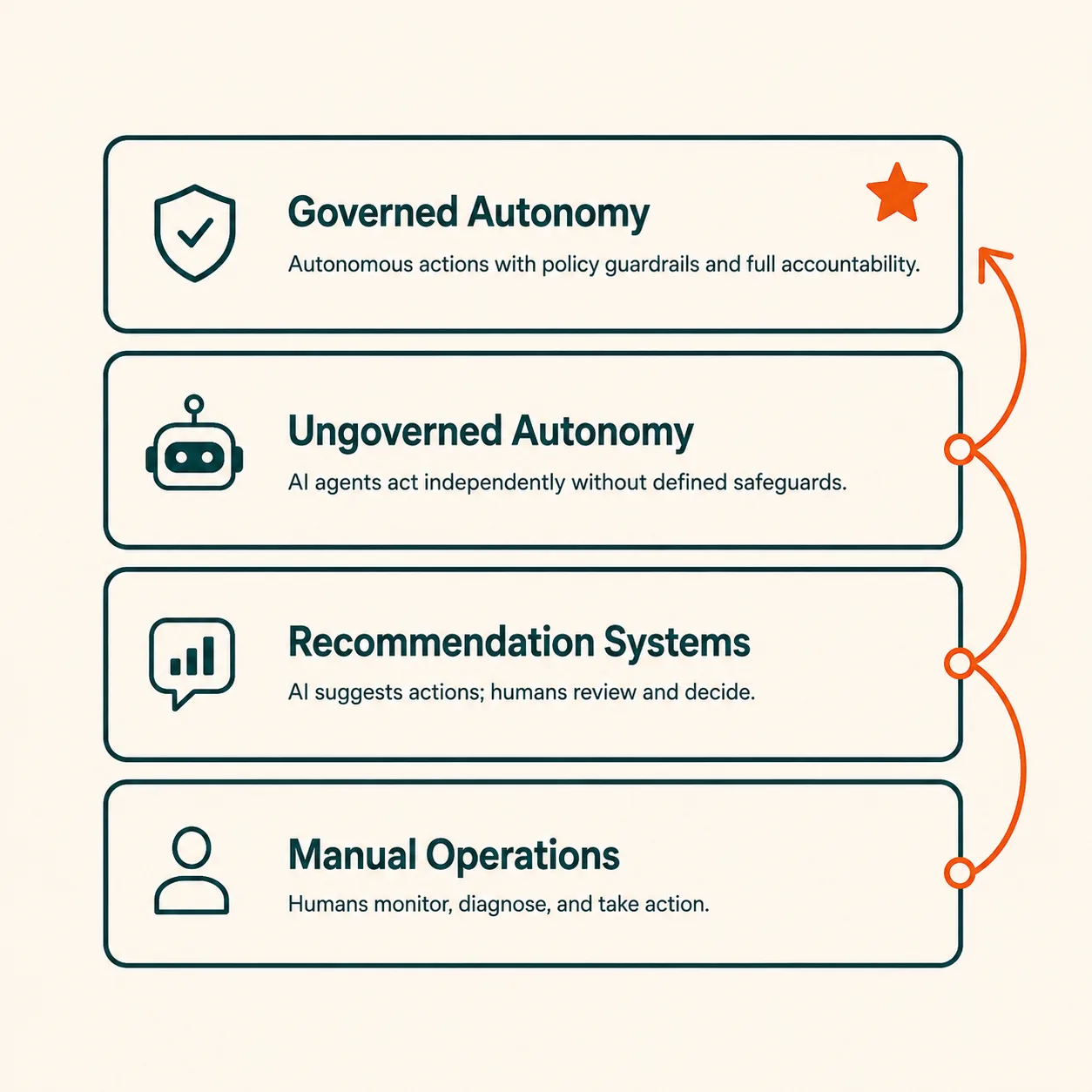
Stage one: manual operations. Engineers respond to alerts, diagnose issues, and execute fixes by hand. Runbooks exist but are often outdated. Mean time to resolution is measured in hours. This is where most enterprises were five years ago and where many smaller teams remain today.
Stage two: recommendation systems. Traditional AIOps platforms surface anomalies and suggest remediation steps. Engineers review the suggestions and execute them manually. This reduces diagnostic time but the human remains the bottleneck. Most large enterprises are at this stage now.
Stage three: ungoverned autonomy. Agents execute actions without human approval. Operational metrics improve dramatically, but governance is ad hoc: policies exist as tribal knowledge, audit trails are incomplete. This is where early adopters of agentic AIOps find themselves today. The operational value is real, and the compliance exposure grows with every action the agents take.
Stage four: governed autonomy. Agents execute actions within explicit, enforceable policies. Every action produces a structured evidence record. Accountability is mapped and traceable. Validation happens in sandbox environments before production deployment. This is the target state. Few organizations have reached it because the tooling has not existed until recently.
Stage four requires a different architecture, and adding more logging to an ungoverned agent will not get you there. Governance has to be designed in from the start.
Where does Moring’s AI control plane fit?
moring’s AI Ops solution applies the control-plane approach to operations agents. moring engineers assemble the required control modules inside your environment and connect them to your identity, cloud, security, data and operations systems. The control plane works alongside the AIOps tools you already use rather than replacing them.
You define what each agent may do. The control path evaluates a proposed action before it reaches a production system, pauses actions that require a person and records the policy result, tool call, approval and outcome.
The same approach can cover autonomous systems beyond operations agents, including coding assistants, customer-service agents and data agents. The exact controls, retention periods and export formats are agreed during implementation based on the workflow and the customer’s requirements.
Key takeaway
Autonomy without governance is a liability that accrues silently until an incident makes it visible. Deploy the guardrails first: a policy engine that bounds every action, an evidence store that records every decision, a named owner for every agent, and a sandbox gate before production credentials. Do this and an auditor’s hardest question becomes a thirty-minute export. Skip it and your first serious agent incident writes the postmortem for you. Retrofitting governance after that incident always costs more than building it in from the start.
→ Ready to govern your autonomous operations agents? Book an AI control plane diagnostic workshop at moring.ai.
Sources
- European Union, Regulation (EU) 2024/1689 (EU AI Act), high-risk system obligations and Article 12 logging.
- European Union, Regulation (EU) 2022/2554 (DORA), ICT risk management and logging requirements for financial entities.
- AICPA, Trust Services Criteria, criterion CC8.1 (change management), as applied to non-human actors in SOC 2 examinations.