


TL;DR: AI agents can take on meaningful preparation work in claims, underwriting, policy servicing, fraud investigation, and complaints handling. The right starting point depends on which workflow your team can evaluate rigorously, not which one looks best in a demo. Keep coverage decisions, risk acceptance, and binding authority with your authorized staff. Use the agent to prepare the file and surface what still needs human judgment.
A pattern emerges across insurance AI pilots: the demo looks clean, the production handoff does not. The agent summarizes the file but leaves your adjuster reopening every source document. It flags a discrepancy but frames it as a conclusion. It routes the request but misses the policy conflict that makes the change impossible.
The question worth asking before deployment is not whether an agent can handle the workflow. It is whether your team can evaluate the agent’s output rigorously enough to trust it in production, and whether the governance layer can prove it operated within its authorized scope on every run.
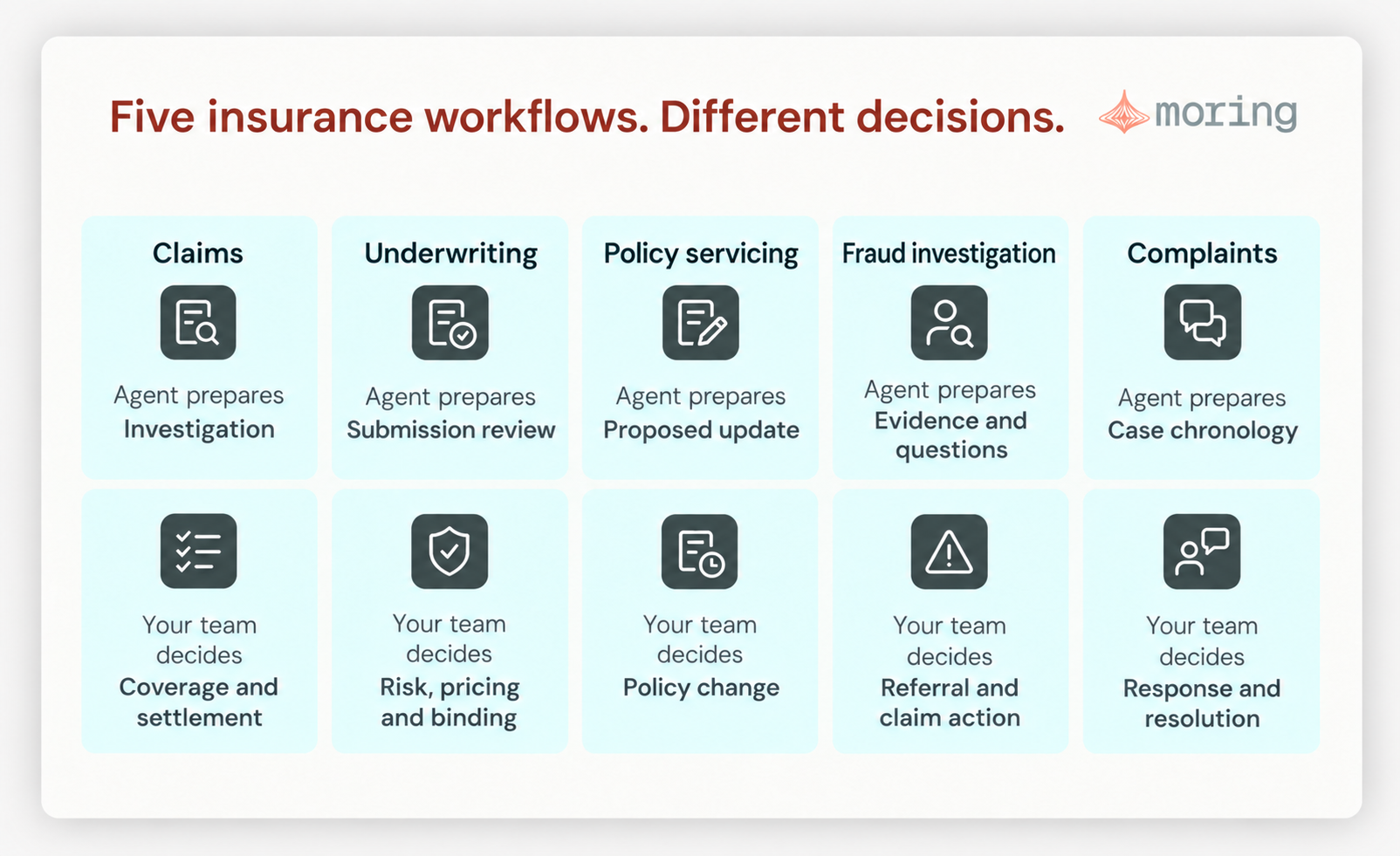
The five workflows below are structured evaluation scopes, each designed around a specific failure mode, a named evaluation signal, and a clear boundary between what the agent prepares and what your authorized staff decides. AI agents for claims, underwriting, and servicing are worth pursuing, but only where you can measure the handoff quality, not just the demo.
Key takeaways
- Start with the workflow your team can evaluate most rigorously.
- Keep coverage, pricing, binding, and escalation decisions with authorized staff.
- Judge the agent on preparation quality, not demo polish.
- Measure what your reviewers still need to reopen after handoff.
The evaluation criteria at the end apply to all five.
1. Claims: Bring the Investigation Together
The failure mode to test for: the agent produces a readable summary but your adjuster still has to locate every supporting document, re-verify the agent’s references, and form their own view of the discrepancies. That is not a useful handoff. It is a formatted version of the original problem.
A useful claims agent does more than compress the file. It connects the supporting material to the specific issues your team needs to examine and identifies the questions that still require adjuster judgment.
What this looks like in practice
Consider an illustrative property claim with photographs, a repair estimate, and correspondence describing the damage. An agent could organize that material around the issues your team needs to examine, linking each observation to its source. If the estimate includes work the photographs do not establish, the useful output is a flagged question for review. The discrepancy alone does not tell you whether the work is justified.
This draws on documented uses of generative AI for extracting information, summarizing insurance documents, and answering questions grounded in policy data. Connecting those capabilities into an investigation is a workflow to evaluate, not a reason to assume the whole claim can be automated.
What stays with your team
Your adjuster receives the assembled material and unresolved questions. Coverage and settlement decisions remain with the people authorized to make them.
The evaluation signal to watch
Pay attention to what your adjuster has to reopen. A readable summary that leaves them searching for every supporting document has not completed much of the preparation.
2. Underwriting: Make the Submission Easier to Assess
The failure mode to test for: the agent flags something in every submission, including clean ones. That behavior trains your underwriters to discount its output, which is worse than no agent at all. A well-designed evaluation set must include submissions that deserve no further question.
Underwriting asks a different question of the same document-reading capabilities: what does this submission tell you about the risk, and where does it specifically need closer examination?
What this looks like in practice
Consider an illustrative commercial submission where the application and an accompanying schedule describe an operation differently. An agent could locate the discrepancy, retrieve the relevant underwriting guidance, and prepare a request for clarification. Your underwriter would see the conflicting descriptions together with their sources.
The value is in the work between noticing an issue and having enough information to assess it. Document-based underwriting assistance is an established area of exploration, including extracting and classifying information to support underwriting decisions.
What stays with your team
Risk acceptance, pricing, and binding authority remain with your underwriters. The agent’s work is judged on how well it prepares the file.
The evaluation signal to watch
A well-designed test set includes submissions that deserve no further question. Otherwise, you could reward an agent for finding something to flag in every file, which is not useful behavior.
3. Policy Servicing: Carry a Request Through the Checks
The failure mode to test for: the agent routes the request to the correct queue but sends it without identifying the conflict that makes the change impossible to complete as submitted. Your service specialist receives a well-formatted case that still requires the same investigation the agent was supposed to perform.
Policy servicing is worth evaluating when a request arrives in ordinary language but completing it involves retrieving several pieces of policy information and checking them against each other.
What this looks like in practice
An agent could identify the requested change, retrieve the relevant policy record, and prepare the next step under your servicing procedure. The important distinction is between understanding what the customer wants and establishing what change can actually be made.
Dates make that distinction tangible. A request received today may ask for a change effective before another transaction already recorded on the policy. Policy administration documentation describes out-of-sequence changes and the conflicts they can create. In a proposed agent workflow, that situation could arrive at your service specialist with the requested date, affected records, and the conflict already identified.
What stays with your team
Binding the change remains within your authorized process. The agent’s role is preparation, not approval.
The evaluation signal to watch
The question for a Head of Policy Operations is how much investigation remains after the handoff. A case sent to the correct queue can still be poorly prepared.
4. Fraud Investigation: Follow the Evidence Without Strengthening It
The failure mode to test for: the agent converts indicators into conclusions. Each step in its reasoning makes the initial suspicion sound more certain, so by the time the output reaches your investigator, what started as an inconsistency has become a finding.
An investigation agent’s usefulness depends entirely on how faithfully it handles evidence as it moves between sources, not on how confidently it frames its output.
What this looks like in practice
There is a consequential difference between a discrepancy worth investigating and an established finding. The National Insurance Crime Bureau’s investigation guide explicitly distinguishes indicators of possible fraud from actual evidence. A proposed scope could assemble a chronology, identify unresolved inconsistencies, and prepare questions for an investigator.
The critical evaluation question
Does the agent preserve alternative explanations, or does each step make the initial suspicion sound more certain? An agent that converts indicators into conclusions before your investigator reviews the file is not useful, it is a liability.
What stays with your team
Your authorized team decides on referral and any action affecting the claim. The agent’s report should make it easy to see what supports a concern and what weakens it.
The evaluation signal to watch
Review a sample of the agent’s outputs for language that overstates certainty. “The claimant’s account is inconsistent with the photographs” is an observation. “The claimant is misrepresenting the damage” is a conclusion the agent has no authority to reach.
5. Complaints: Reconstruct the Customer’s Experience
The failure mode to test for: the agent produces an accurate process chronology that still misses why the customer complained. It follows internal categories more closely than the customer’s account, so your complaints team receives a well-organized file that does not address the actual concern.
A complaint is a useful evaluation scope precisely because it tests whether the agent can reconstruct a sequence of interactions from the customer’s perspective, not just retrieve and sort internal records.
What this looks like in practice
In an illustrative case, a customer says a promised callback never happened. The file contains a note saying the callback was requested, but no record that it was completed. An agent could gather the correspondence and activity history, then surface that gap without converting the request into a completed contact.
Your complaints team could receive the customer’s concern, the relevant sequence of events, and the questions still open. The response and resolution remain with your authorized staff.
The evaluation signal to watch
The evaluation should include the customer’s actual concern. An accurate chronology can still miss why someone complained, particularly if the report follows internal categories more closely than the customer’s account. Test with cases where the process record looks correct but the customer’s experience was not.
How to Choose the Workflow Your Team Can Evaluate
You do not need to rank these workflows in the same order as another insurer. Your best starting point depends on the records you can access, the process owners who can judge the work, and the governance your organization requires.
For each candidate workflow, bring these questions into the discussion:
- What would your team receive? A claims investigation, a submission review, and a proposed policy update have different standards of completion.
- Who can judge it? Name the process owner and the people who will review representative cases.
- Can it reach the right records? Include policy versions and supporting material, not just the documents convenient for a demo.
- What happens when the evidence disagrees? Choose examples with ambiguity as well as straightforward cases.
- What work remains with your team? Measure corrections and follow-up alongside preparation time.
- Which decisions stay in your existing process? Make those explicit for the scope being evaluated.
The Governance Layer Matters as Much as the Workflow Scope
An approval button is not a governance layer. The question of who owns the agent versus who approves its work is a design decision with regulatory consequences in insurance, not an afterthought. Ownership, scope boundaries, and escalation paths need to be defined before the agent touches a live case.
The NAIC’s model bulletin addresses AI systems that make or support regulated insurance decisions, with governance proportionate to the risks involved. It is a model for state adoption; your compliance team should work from the applicable jurisdiction’s requirements.
For production deployments, observability across agent actions gives your operations team the evidence they need to demonstrate that the agent operated within its authorized scope on every run. Without that record, you cannot distinguish a well-governed agent from one that drifted. That evidence gap is what separates a promising pilot from a defensible production system.
The AI Control Plane enforces those controls at runtime: identity, policy boundaries, approval routing, and the action-level audit trail your compliance team needs. The first workflow gives you a chance to test what useful delegation looks like in your operation. When your reviewers can articulate what the agent handled well and what still needed their attention, that clarity is what earns the next workflow a chance.
Start where your team can evaluate the agent rigorously, keep consequential decisions with authorized staff, and measure how much rework remains after handoff.
You can explore Moring’s approach to AI agents in insurance, or bring a candidate workflow to the insurance AI workshop to map its review points, the records it needs, and the evidence your team requires to trust it in production.