
AI agent orchestration is the coordination layer that routes requests, chains tasks, and manages handoffs between multiple AI agents working toward a shared outcome. Governing it from one place means establishing a single control plane that enforces policy, logs every decision, and maintains visibility across all orchestration patterns—whether you run pre-built workflows, dynamic routing, or fully autonomous swarms.
Why enterprises are suddenly wrestling with orchestration governance
Two years ago, most organizations ran one or two isolated LLM pilots. Today, the same teams face dozens of agent implementations: a customer-support triage agent hands off to a knowledge-retrieval agent, which calls a code-generation agent, which invokes a database query agent. Each handoff introduces a decision point, a new model, and another surface for drift, hallucination, or policy violation.
Orchestration emerged to solve the “too many agents” problem. Frameworks like LangGraph, CrewAI, and AutoGen let developers define workflows that chain agents together. Cloud providers offer managed orchestration services. The result is faster deployment and more capable systems, but also a governance vacuum. When an agent chain produces a wrong answer or leaks sensitive data, tracing the failure back through five handoffs and three model providers becomes an archaeological exercise.
Regulators and auditors now ask: which agent made the final decision? What data did it see? Was the output reviewed before reaching a customer? A single orchestration platform with no governance layer cannot answer those questions.
What orchestration actually does (and the three patterns enterprises deploy)
Orchestration coordinates multiple agents to complete a task no single agent can handle alone. It manages three responsibilities: routing incoming requests to the right agent, passing context and intermediate results between agents, and deciding when to terminate or escalate.
Three patterns dominate production deployments. Sequential workflows chain agents in a fixed order—agent A summarizes a document, agent B extracts entities, agent C writes a report. Dynamic routing uses a controller agent to examine the request and select the next step at runtime—a support query might route to billing, technical, or escalation agents based on intent classification. Autonomous swarms give agents partial autonomy to spawn sub-agents, delegate tasks, and self-organize—a research agent might spawn three parallel web-search agents, then synthesize their findings.
Each pattern multiplies complexity. A five-agent sequential workflow has five model calls, five prompt templates, and five output schemas to govern. A dynamic router adds branching logic and confidence thresholds. A swarm adds emergent behavior that no developer explicitly programmed.
Why traditional governance tools fail at the orchestration layer
Most AI governance platforms treat each model call as an isolated event. They log the prompt, the response, the latency, and the token count. This works for single-agent systems. It breaks the moment you introduce orchestration.
The core problem is loss of causality. When agent C hallucinates a fact, you need to trace it back to agent A’s retrieval step and agent B’s parsing logic. Traditional logging captures three disconnected events with no parent-child relationship. You see the bad output but cannot reconstruct the chain of reasoning that produced it.
Policy enforcement fragments across tools. Your prompt firewall blocks toxic content in agent A. Your data-loss-prevention system scans agent C’s output. Nothing checks whether agent B leaked a customer ID into its intermediate reasoning trace, which never left the orchestration layer but sits in a log file waiting for the next breach.
Auditability collapses under manual assembly. An auditor asks: “Show me every decision this orchestration made on March 15th.” You export logs from four systems, write a Python script to correlate timestamps, and hope you caught every handoff. The auditor leaves unimpressed.
The framework: five pillars of orchestration governance
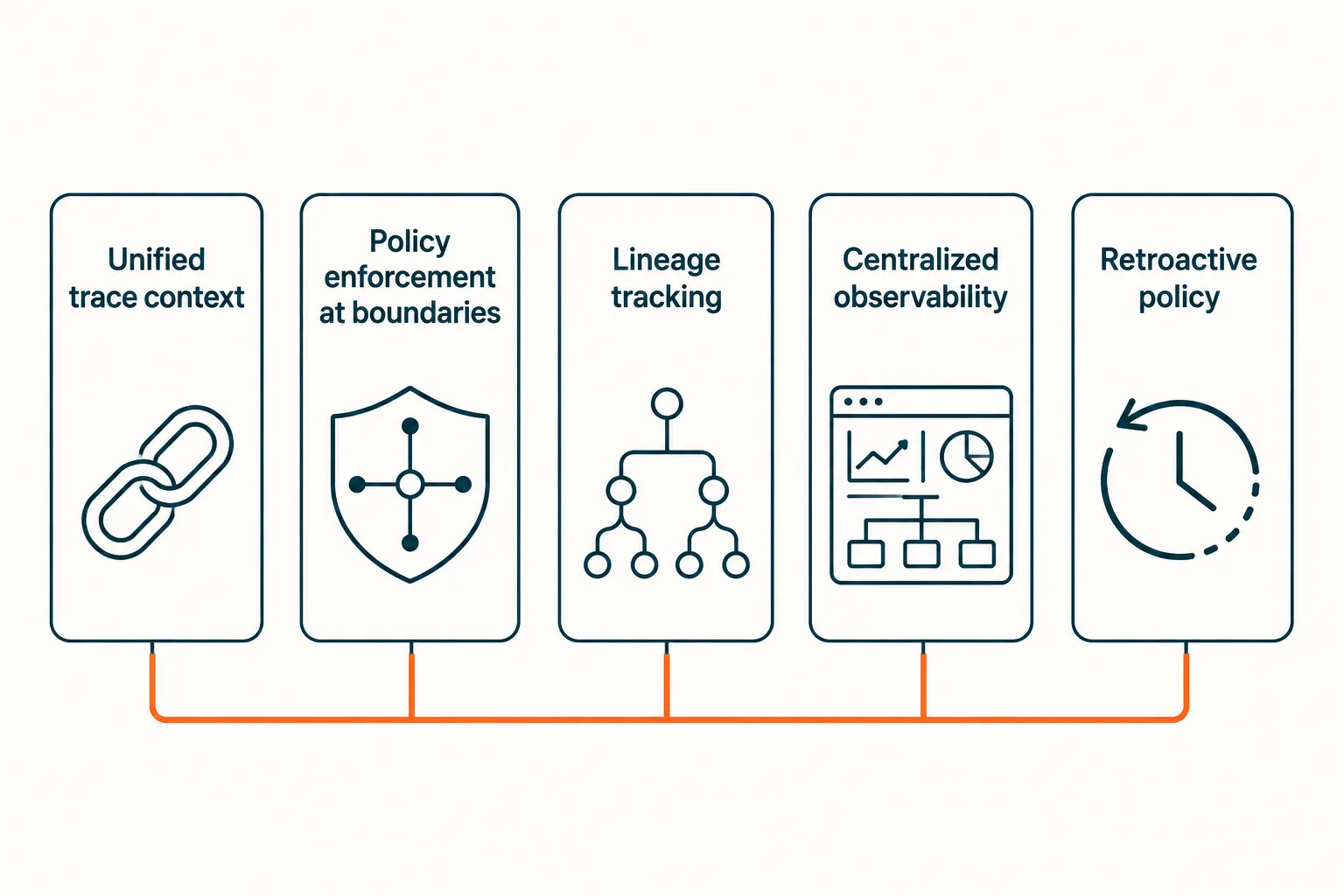
Effective orchestration governance rests on five pillars. Implement all five, and you can govern any orchestration pattern from a single control plane. Miss one, and you create a blind spot.
1. Unified trace context. Every agent call, handoff, and decision must belong to a single trace ID that persists across the entire orchestration. When agent D fails, you pull one trace and see the full chain: user query → router decision → agent A retrieval → agent B parsing → agent C reasoning → agent D execution. This requires instrumentation at the orchestration framework level, not just the model API.
2. Policy enforcement at every boundary. Policies must execute before and after each agent, not just at the orchestration entry and exit points. Check input data classification before agent A touches it. Validate agent B’s intermediate output against a schema before passing it to agent C. Block agent D from calling an external API if the trace context indicates PII in flight. Boundary enforcement prevents a compliant agent A from handing toxic input to an ungoverned agent B.
3. Lineage tracking for data and decisions. Every output must link back to its inputs. When agent C cites a fact, the governance layer records which document agent A retrieved, which sentence agent B extracted, and which reasoning step agent C applied. This is not the same as logging; it is constructing a directed acyclic graph of data flow. Lineage enables root-cause analysis and satisfies “right to explanation” requirements under GDPR and the EU AI Act.
4. Centralized observability with orchestration-aware views. A dashboard that shows “500 agent calls today” is useless. You need views that show orchestrations as units: “50 customer-support orchestrations completed, 3 escalated to humans, 1 hit a policy block at the third handoff.” Aggregate metrics by orchestration type, trace success and failure rates, and surface anomalies like an agent that suddenly starts spawning twice as many sub-agents.
5. Retroactive policy application. Policies evolve faster than code. When you discover that agent B has been leaking internal project names for two weeks, you need to retroactively scan all traces involving agent B, identify affected orchestrations, and flag them for review. This requires immutable trace storage and a policy engine that can run new rules against historical data.
How teams govern orchestration today (and where each approach breaks)
Manual trace reconstruction. Developers instrument each agent with custom logging, dump everything to a data lake, and write scripts to stitch traces together during incidents. This works for ten orchestrations. It fails at a hundred. The correlation logic becomes a second codebase. Logs from different agents use different timestamp formats. Intermittent network issues create gaps. An auditor asks for a report, and you spend three days writing SQL.
Orchestration-framework-native observability. LangGraph and CrewAI offer built-in tracing. This solves trace context but provides no policy enforcement. You see the full chain of agent calls, but you cannot block an agent from accessing a dataset or require human review before finalizing an output. You still need a separate governance layer, and now you are exporting traces from the framework into another system.
APM tools extended to AI. Teams adapt Datadog or New Relic to capture LLM calls. These tools excel at latency and error rates. They do not understand agent semantics. A trace shows five HTTP calls to OpenAI, but it does not know that call three was a routing decision and call four was a retrieval step. You cannot write a policy that says “block any orchestration where the retrieval agent returns more than ten documents.” The tool sees API calls, not agent roles.
Homegrown control planes. Platform teams build a centralized service that wraps all agent calls. Every agent must route through the control plane, which enforces policy and logs decisions. This works until the organization adopts a new orchestration framework or a team deploys agents in a different cloud region. The control plane becomes a bottleneck. Latency increases. Teams route around it.
The recommended approach: an AI control plane purpose-built for orchestration
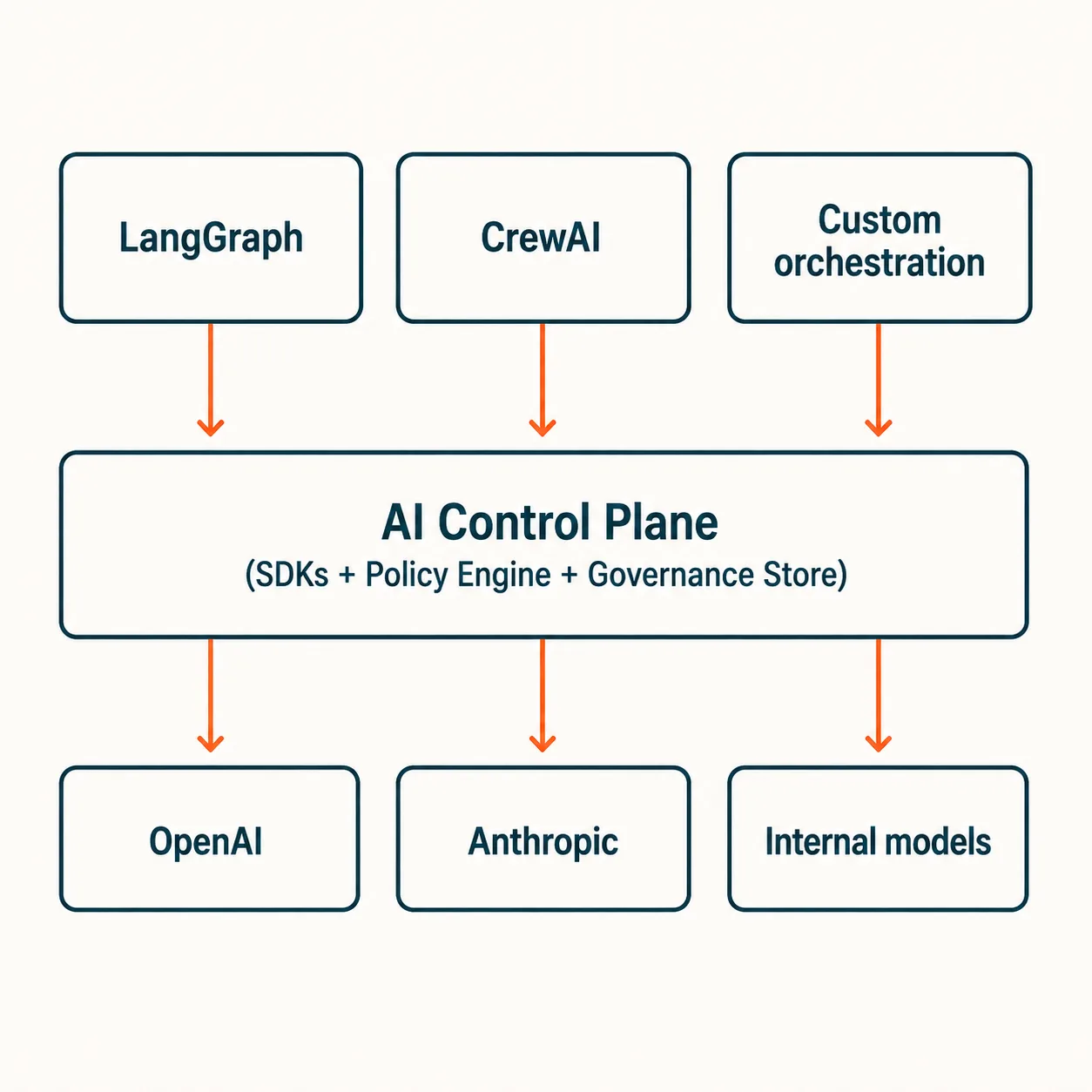
A purpose-built AI control plane sits between your orchestration layer and your models. It instruments every agent call, enforces policy at every handoff, and maintains a single source of truth for all traces.
The architecture has three components. Agent SDKs wrap your orchestration framework—LangGraph, CrewAI, custom code—and inject trace context into every agent call without requiring you to rewrite workflows. A policy engine evaluates rules at every boundary: before agent A retrieves data, after agent B generates a summary, when agent C attempts to call an external API. Rules reference trace context, so you can write policies like “block any orchestration that has touched PII and now attempts to log output to an external system.” A governance data store captures every trace, every policy decision, and every lineage relationship as immutable records. When an auditor asks for evidence, you run a query, not a three-day log-mining project.
This is where Moring’s platform enters. Moring provides the agent SDKs, the orchestration-aware policy engine, and the governance data store as a single control plane. You deploy Moring alongside your existing orchestration framework. The SDKs auto-instrument your agents. You define policies in a central console—“require human review for any healthcare orchestration that cites fewer than three sources”—and Moring enforces them at every handoff. When a trace violates a policy, Moring blocks the next agent call and logs the decision. When an auditor requests evidence, you export a compliance report filtered by orchestration type, date range, and policy outcome.
A worked example: governing a customer-support orchestration
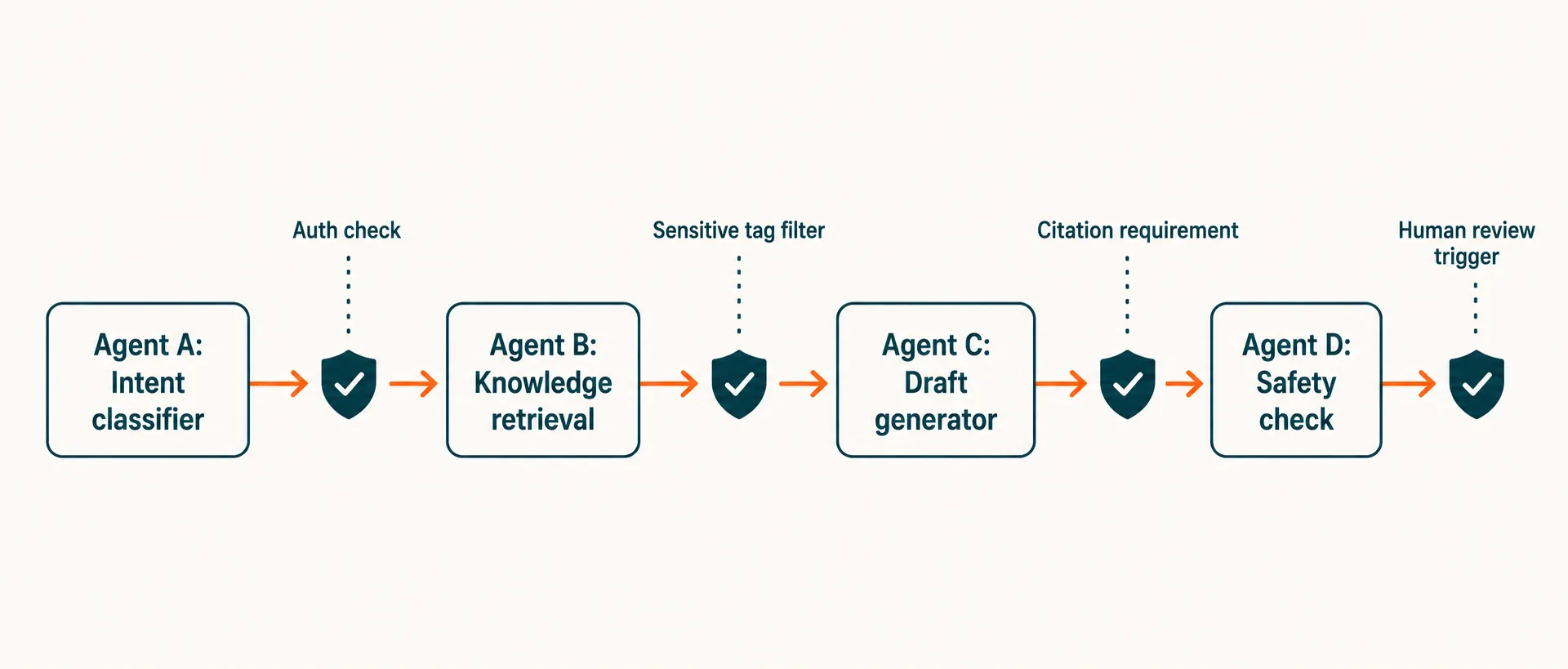
Consider a customer-support orchestration with four agents. Agent A classifies the query intent. Agent B retrieves relevant knowledge-base articles. Agent C generates a draft response. Agent D performs a final safety check and either sends the response or escalates to a human.
Without governance, this chain has multiple failure modes. Agent B might retrieve an article containing a customer’s internal account notes. Agent C might hallucinate a refund policy. Agent D might pass a response that violates your brand guidelines.
With a control plane, you define policies at each boundary. Before agent B retrieves articles, check that the query contains no PII and that the user has authenticated. After agent B returns results, validate that no article contains sensitive tags. Before agent C generates a response, inject a system prompt requiring citations. After agent C produces a draft, run a toxicity scan and a brand-compliance check. Before agent D sends the response, require human review if the query involved billing or if agent C’s confidence score fell below 0.85.
When the orchestration runs, the control plane enforces every policy. Agent B attempts to retrieve an article tagged “internal-only.” The control plane blocks the retrieval and logs a policy violation. The orchestration halts. A platform engineer receives an alert. They review the trace, see that agent A misclassified the query, and update the classifier’s training data. The next orchestration succeeds.
Two weeks later, an auditor asks: “How do you ensure customer-support agents never expose internal account notes?” You open the governance console, filter traces by orchestration type “customer-support,” and export a report showing that 127 orchestrations triggered the “internal-only” block policy, and zero orchestrations sent a response containing sensitive tags. The auditor signs off.
Key takeaway
AI agent orchestration introduces governance complexity that single-agent systems never faced. Governing it from one place requires a control plane that understands orchestration semantics—trace context, agent boundaries, lineage, and policy enforcement at every handoff. Manual log reconstruction and APM tools extended to AI cannot provide this. A purpose-built AI control plane instruments your orchestration frameworks, enforces policies at every boundary, and maintains a single source of truth for audits. Implement the five pillars—unified trace context, boundary enforcement, lineage tracking, centralized observability, and retroactive policy application—and you can govern any orchestration pattern, from sequential workflows to autonomous swarms, without rewriting code or fragmenting policy across tools.
Book an AI Control Plane diagnostic workshop to map your orchestration patterns and identify governance gaps: moring.ai/contact