

Key takeaways
- AI-DLC changes how work moves from an initial request through implementation and operation. Code generation is one part of that workflow.
- Your team still needs to resolve ambiguous requirements, choose acceptable tradeoffs and review evidence before release.
- A useful first application is an actual change with clear acceptance criteria, failure tests and someone responsible for its behavior after deployment.
Your team can generate a convincing implementation before everyone has agreed what the change should do. That is an awkward place to be. The pull request looks ready, the tests pass, and the unanswered questions are now buried in code that someone has to review.
AI-DLC changes how that work begins and moves forward. The agent helps turn a request into a plan, asks for clarification and carries the validated context into implementation and operation. Your team’s work includes challenging those proposals before they become the basis for the next stage. That gives you an earlier opportunity to catch a plausible solution to the wrong problem.
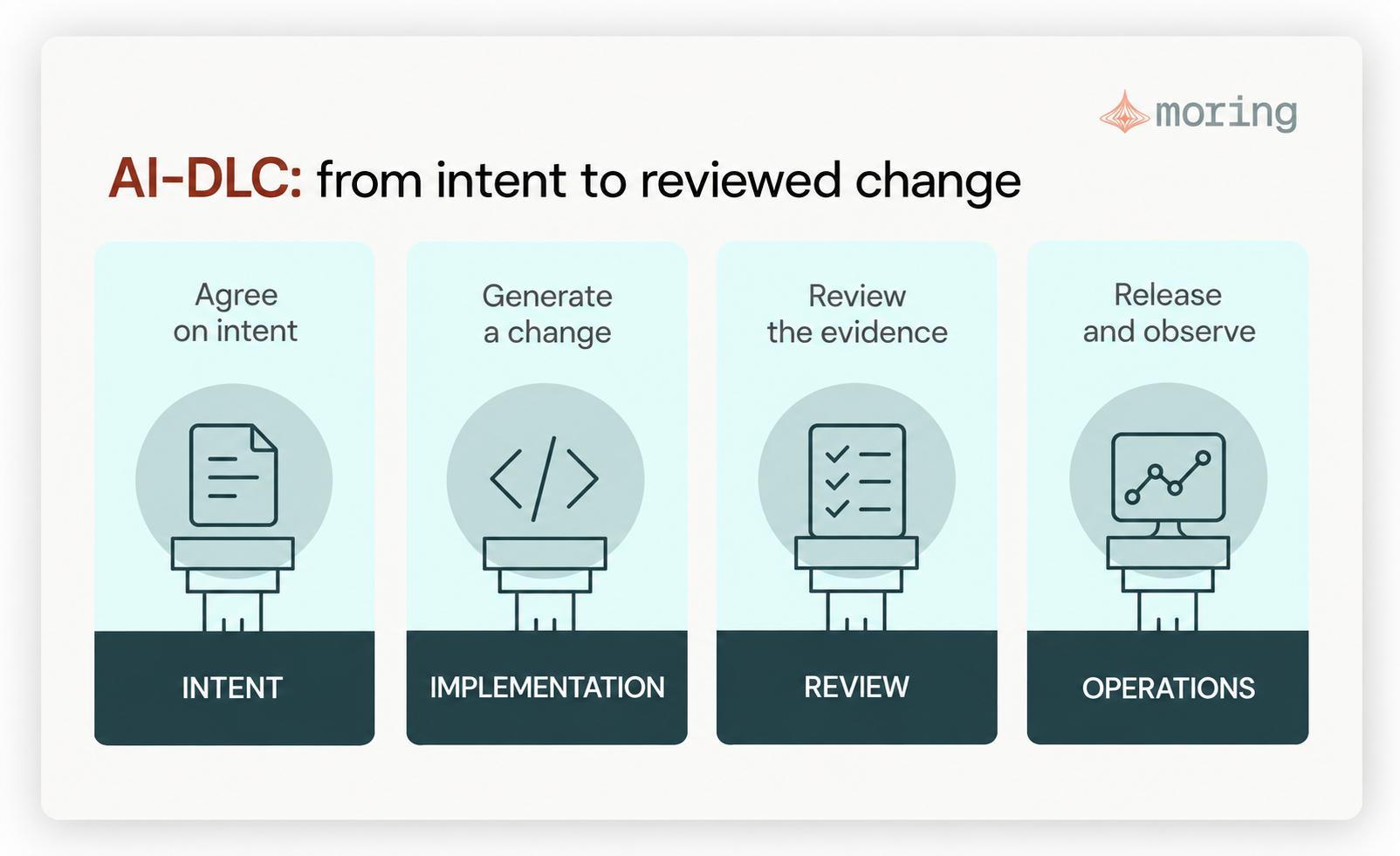
In AWS’s AI-Driven Development Life Cycle, AI participates throughout Inception, Construction and Operations. It helps develop plans and artifacts while people clarify intent and validate consequential decisions. The useful idea is that planning, implementation and operation can share context instead of treating each AI interaction as a fresh start.
AI-DLC and AI-SDLC: which distinction matters?
Adding AI to familiar development tasks could mean drafting tests, explaining code or suggesting an implementation. AWS’s AI-DLC describes a broader workflow: during Inception, the team works through AI-generated questions and requirements; during Construction, it clarifies proposed architecture and implementation; during Operations, the accumulated context informs infrastructure and deployment work under team oversight.
The practical difference is continuity. A decision made while clarifying the request becomes an input to later work, where your team can check whether the implementation still reflects it. If you are comparing AI-DLC with an approach called AI-SDLC, look for that behavior in the proposed process. The acronym alone does not establish it.
For this article, AI-DLC means the AWS methodology linked above. The workflow below is an illustrative application, with additional engineering choices your team would need to make. It is not a claim that adopting the methodology automatically supplies approval controls, test coverage or a complete audit record.
Start with the question hiding inside the ticket
Take a concrete example: your service needs to retry delivery of payment event notifications when a receiving endpoint is temporarily unavailable.
“Add retries” sounds specific until you try to implement it. Which failures should trigger another attempt? How long can delivery remain pending? What happens if the receiver processes an event but the acknowledgment never reaches you?
An agent can help expose those questions and draft a proposal. Your team then has something concrete to discuss: retry limits, backoff behavior, event identifiers and the point at which delivery becomes an operational exception.
The receiver’s behavior matters too. Retrying the same event safely depends on how duplicate deliveries are recognized and handled. A sender cannot establish that guarantee simply by adding an idempotency key to a request.
Recording those decisions gives implementation and review a shared starting point. They can change as you learn more, but a change to the requirement should be visible. Otherwise, the agent may solve an easier problem than the one your team intended.
Give implementation the context your reviewers already use
The retry decisions now need to reach the implementation. If the team agreed that invalid payloads should stop immediately, the agent needs that rule alongside the repository’s existing retry utility and error-handling conventions. Otherwise, it could reuse a general retry pattern that keeps resending a request the receiver will never accept.
Those details belong in the agent’s working context. You can ask it to identify the existing pattern, explain where the proposed change fits and surface conflicts before editing. That makes the review more useful than discovering afterward that a plausible implementation duplicates something you already maintain.
Context also has boundaries. Access to the repository does not imply permission to read production secrets or call a live payment endpoint. If your development agents connect through MCP, the identity and tool-access decisions involved in taking MCP to production apply here as well. A tool being available and a particular operation being authorized are separate questions. For the governance side of the AI delivery lifecycle, see the Moring AI Governance hub.
Review the behavior, including the uncomfortable cases
That implementation gives review a specific question: did the agreed failure behavior survive the move into code? A test that checks only eventual delivery could pass even if the handler also retries permanently invalid payloads. For the notification example, review needs to cover both that distinction and deliveries with an uncertain outcome.
A practical review works through these cases:
- Temporary failure: the receiver is unavailable, then recovers. Does delivery resume within the agreed limits?
- Lost acknowledgment: the receiver processes the event, but the sender times out. Can another delivery produce a duplicate business action?
- Permanent rejection: the payload is invalid. Does the workflow stop retrying and expose the exception?
- Service restart: the sender restarts with deliveries pending. Can it recover the delivery state without silently losing work?
These are suggested checks for the fictional workflow, not an exhaustive test plan. The point is to evaluate the proposed behavior against requirements your team understands independently of the generated code.
An agent can draft a review, too. Keeping its suggestions distinguishable from the human review makes it easier to see which concerns were raised and how they were resolved. That record also helps when you need to examine who made a decision involving an AI agent.
Carry the decision into release and operation
The same distinction carries into operation. A delivery waiting for another attempt and an invalid payload awaiting intervention need different responses. If both appear as a generic failure, the person on call has to reconstruct a decision your team already made. Release readiness therefore includes a way to see pending deliveries, inspect stopped cases and intervene when the retry behavior is wrong.
Rollback needs thought because code and delivery state are different things. Reverting the code does not undo notifications already delivered or resolve events currently in flight. Your release plan should explain how those cases will be handled.
A useful change record connects the requirement, implementation, test results and approval to the release. Where it helps investigation, retain the agent configuration and references to the context used. Sensitive prompts and source material need appropriate access and retention controls; collecting everything is not automatically useful.
A checklist for your first AI-DLC change
Before expanding this approach, take one completed change and ask:
- Can someone explain the intended behavior without reverse-engineering the code? For this change, a reviewer should be able to find the retry conditions and stop rules in the agreed requirement.
- Are unresolved assumptions visible, with an owner who can settle them?
- Did review cover failure behavior as well as the successful path?
- Were the agent’s repository and tool permissions appropriate for the task?
- Can you connect the deployed version to its tests and approval? A release reference that leads to the reviewed change and its test results is more useful than an unlinked screenshot of a passing build.
- Does the service owner know what to monitor and how to intervene? Try walking through a stopped delivery together, including where to find it and who takes the next action.
The answers show where your delivery process needs attention. They may point to better requirements, a missing integration test or an operational handoff that still happens informally.
That is a useful conversation to have before adding more automation. If you are exploring AI-DLC with Moring, bring a change your team has actually struggled to ship. Its unresolved decisions will tell you more about where AI can help than a demonstration built around a task with no ambiguity.
Sources
Governing Autonomous AI Agents in Production
Moring provides the runtime control layer, identity verification, human-in-the-loop approvals, and audit records needed to deploy production-grade AI agents safely.
About the author

Arya SharanProduct Marketing & GTM, Moring AIChennai
Owns product marketing and go-to-market at Moring AI across positioning, demand and enablement. Works with regulated buyers on how governed AI agents are scoped, evaluated and bought. Writes about the operating questions that decide whether an agent reaches production.
LinkedIn profile