

TL;DR: AIOps, AI SRE and agentic incident response overlap, and the label on a product tells you little about what it can observe, decide or change. Compare them by the work they change across five stages: detection, investigation, recommendation, execution and recovery verification. The consequential shift is tool use. Once a workflow can change a production system, identity, permissions, approval and stop conditions become part of the incident design rather than procurement questions.
Key takeaways
- AIOps, AI SRE and agentic incident response overlap. Compare them by the work they change, not by the label on the product.
- The practical differences appear across five stages: detection, investigation, recommendation, execution and recovery verification.
- The greatest change comes when a system can use operational tools. At that point, identity, permissions, approval and stop conditions become part of the incident design.
- A good evaluation starts with one incident class and a written authority boundary. It does not start with a broad promise to automate operations.
Your monitoring system detects an error-rate increase. An analytics layer groups related alerts. An assistant summarizes the likely services involved. An agent queries recent changes, proposes a rollback and waits for approval. Another workflow executes the rollback and checks whether the service has recovered.
All of those systems may be described as AIOps. Some may be sold as AI SRE. The last two are often described as agentic incident response. The terms are used inconsistently, so the name alone tells you little about what the system can observe, decide or change.
A more useful comparison follows the work of an incident. Ask what the system does at each stage, whose authority it uses and what evidence a responder can inspect before the next step.
This article uses working definitions for comparison. They are not formal industry standards, and the boundaries vary across teams and products.
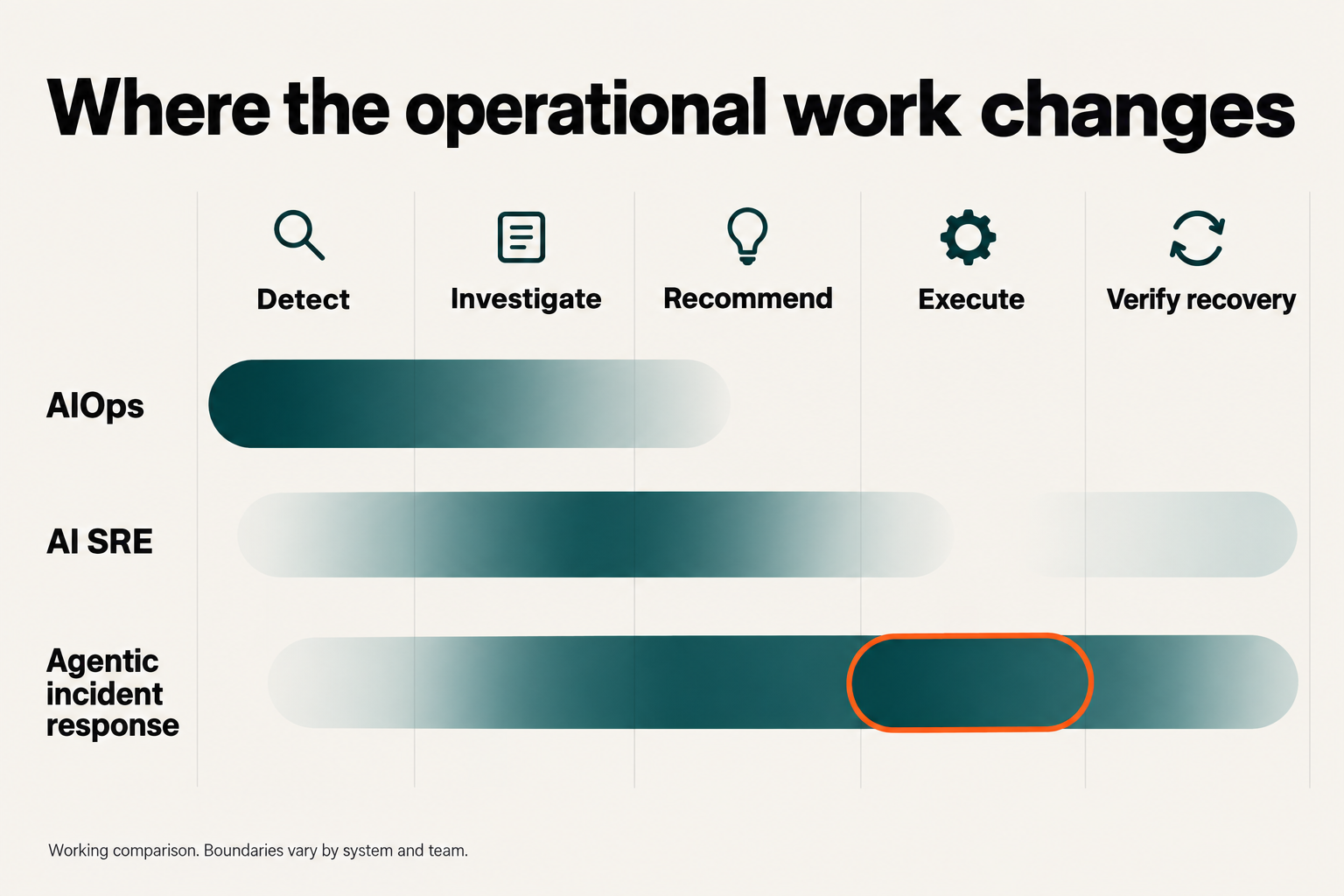
Start with the incident lifecycle
Google’s guidance on monitoring describes monitoring as support for alerting, investigation, diagnosis, visual understanding and longer-term planning. It also explains why an alerting view rarely contains enough information to establish a cause. Responders need to move from a signal that shows a service problem to changes, dependencies and other evidence that may explain it.
That distinction gives you a useful five-stage comparison:
- Detection: establish that a condition needs attention.
- Investigation: gather and connect evidence about impact, changes and dependencies.
- Recommendation: propose a next action and explain the basis for it.
- Execution: use a tool to change the operating environment.
- Recovery verification: check whether the action restored the service and whether impact remains.
The stages are not always linear. A failed mitigation can return the incident to investigation. New evidence can narrow or overturn an earlier hypothesis. Recovery verification can reveal that one metric improved while customer impact continued.
The value of this model is that it makes the system’s responsibility visible. “Automates incident response” is too broad to evaluate. “Correlates alerts and opens a case” or “prepares a rollback for an authorized responder” can be tested.
What AIOps usually changes
AIOps commonly begins with operational data at scale. It can group alerts, detect unusual behavior, correlate events, identify recurring patterns and route work to the right team. In the five-stage model, its center of gravity is detection and early investigation.
Consider a service that produces twenty alerts after one dependency begins timing out. An AIOps workflow might group those alerts into one incident, show the affected services and attach a recent change event. That reduces the amount of sorting a responder has to do.
It does not establish that the change caused the incident. Time proximity is evidence to examine, not a causal conclusion. The same alert cluster could coincide with a dependency failure, a traffic shift or stale telemetry.
This is where the underlying data matters. OpenTelemetry distinguishes traces, metrics and logs because each signal describes a different part of system behavior. A correlation system needs stable service identity, time context and enough shared attributes to connect those signals. If one platform calls the service checkout-api and another calls it payments-prod-7, the analysis begins with an identity problem.
Telemetry is also an input with its own trust boundary. A USENIX Security 2026 pre-publication paper on telemetry manipulation describes a threat model in which manipulated telemetry can influence an AIOps agent’s remediation. The practical implication is narrower than treating all telemetry as hostile: preserve source and structure, distinguish user-controlled content inside a signal, and do not let an instruction embedded in a log become an operational command. Observability for AI agents covers the metrics, traces and guardrails that make a signal trustworthy enough to act on.
For an AIOps evaluation, ask:
- Which signals and change records can it read?
- How does it group events, and can a responder see why they were grouped?
- Does it preserve conflicting signals?
- Can it distinguish missing data from a healthy result?
- Does it create a recommendation, or only route the incident?
The answers describe the operating change more accurately than the category name.
What AI SRE usually changes
AI SRE often refers to AI assistance applied to the work of a site reliability team. That can include explaining an alert, querying telemetry, drafting a runbook step, estimating the likely scope of impact or preparing a change for review.
The important shift is context. A useful SRE workflow needs more than the alert. It needs the service objective, ownership, recent changes, dependency graph, operating procedures and the limits of the current responder’s authority.
Suppose an error budget is burning quickly on a customer-facing API. An AI SRE assistant could retrieve the relevant service-level objective, identify which endpoints account for the increase, compare the timing with recent releases and draft two competing explanations. It could then propose the next diagnostic query for each explanation.
That is broader than alert correlation, but it may still be read-only. “AI SRE” does not automatically mean that the system can restart a workload, change a feature flag or roll back a release.
The distinction matters because recommendation quality and action authority are different controls. A system may be good at assembling evidence and still be unsuitable for direct production access. Conversely, a tightly scoped action may be safe to automate even if the system cannot explain an entire incident.
For an AI SRE evaluation, ask:
- Can it retrieve the service context responders already use?
- Does it separate observed evidence from a hypothesis?
- Can it show the query, time window and source behind a statement?
- Which diagnostic tools can it use without approval?
- What does it do when sources disagree or a query fails?
These questions reveal whether the workflow helps a responder reason about the incident or merely writes a fluent summary.
What agentic incident response changes
Agentic incident response describes a workflow in which an agent participates across several incident stages and can use tools to move the work forward. The agent may open an incident, gather evidence, call diagnostic tools, prepare or execute a mitigation and verify the result.
Tool use is the consequential boundary. Once a workflow can change a production system, its design must answer four concrete questions:
- Identity: which user, service or agent is making the call?
- Permission: which operation and resource are allowed in this incident?
- Approval: which actions need a named person to authorize a specific proposal?
- Evidence: what request, result, decision and state change will be retained?
A safer design avoids giving an agent one broad production credential. It gives each operation an explicit path. Read-only diagnostic access can be available at the start. A reversible mitigation may become available after a responder approves the exact target and parameters. A destructive or poorly bounded action may remain unavailable. Graduated authority for AIOps agents sets out that ladder in full, and agentic AIOps: who governs the ops agents now acting on their own covers who owns the policy behind it.
Moring’s AI Control Plane holds those four answers in one place for operational agents: the identity each tool call uses, the actions available at each authority level, the approval tied to a specific proposal, and the record of what changed. Its AI Ops agents are the applied version: triage, root-cause evidence, runbook recommendation, remediation after approval, and an incident record kept while the incident is still open. The reason to settle this before the first remediation agent ships is that the security review is what holds it up, and that review goes faster when authority levels, approvals and records are properties of the platform rather than of one team’s runbook.
This is also where stop conditions matter. If the evidence no longer matches the approved plan, the workflow should return for review. If a rollback does not improve the relevant service measure, the agent should not continue through a sequence of increasingly broad changes. The human handoff needs a defined trigger and a usable evidence packet.
For an agentic incident-response evaluation, ask:
- Which actions are structurally available, not merely discouraged in a prompt?
- Is approval tied to an exact action, target and current state?
- Can the agent detect that the state changed after approval?
- What stops repeated or expanding remediation attempts?
- How is recovery verified independently of the action result?
A successful API response means the tool accepted a command. It does not mean the service recovered.
One incident, three different operating changes
Use a fictional incident to make the comparison concrete. At 10:04 UTC, an API’s request error rate rises. Several services page at once, and a configuration change completed at 09:58 UTC.
An AIOps workflow groups the alerts, identifies the shared dependency and adds the configuration change to the incident timeline. Its output is a better starting point for investigation.
An AI SRE workflow queries traces around the failed requests, checks the dependency’s latency and compares instances with and without the new configuration. It concludes that the change is a plausible contributor, while showing that one region has a different failure pattern. Its output is an evidence-backed investigation and a proposed next check.
An agentic incident-response workflow prepares a rollback of the configuration for the affected region. It shows the target, current version, expected effect and verification query. An authorized responder approves that proposal. The agent executes the rollback, then checks error rate, latency and customer-impact measures over the agreed window. If recovery is partial, it returns the incident to investigation instead of declaring success.
These could be three products, three configurations of one platform or three stages in one operating model. The architecture matters less than whether the responsibilities and authority are clear.
Recovery verification deserves its own stage
Operational automation often treats execution as the end. It is only the start of the test.
A rollback can complete successfully while the service remains impaired. A restart can reduce queue depth while dropping work. A feature flag can restore one endpoint while moving failures to another dependency.
Recovery verification should therefore name:
- the service measures that must recover;
- the customer or business measure that must improve, when one is available;
- the observation window;
- the expected side effects;
- the condition that sends the incident back to a person.
The agent should retain the pre-action values, action result and post-action observations. That creates a record that a responder can review and challenge. It also makes repeated incidents easier to compare without turning the previous incident’s explanation into an assumption. Keeping stakeholders informed while that verification runs is its own workflow, covered in AI agents for incident updates.
How to choose the first workflow
Pick an incident class your team can replay from real evidence. A narrow, frequent and well-instrumented failure is more useful than a broad demonstration built around a perfect runbook.
Write down the boundary before selecting tooling:
- Which signals and systems can the workflow read?
- Which incident stage should it improve first?
- Which actions, if any, can it prepare or execute?
- Who approves a consequential action?
- Which evidence must appear before approval?
- How will the team decide that the service recovered?
Then replay several past incidents in time order. Reveal evidence as it became available, not all at once. Measure whether the workflow reduces sorting and retrieval work, preserves uncertainty and gives responders a useful next step. If it recommends action, check whether the cited evidence actually supports that action.
The category label can wait. What matters first is which part of the incident changes, and which calls stay with the people carrying the pager.
So pick one incident class, write the boundary down, and replay last month’s incidents against it. By the end of that exercise you will know which capabilities you actually need and why.
Sources
- Google SRE Workbook: Monitoring
- Google SRE Workbook: Incident response
- OpenTelemetry: Signals
- OpenTelemetry specification: Log correlation
- USENIX Security 2026 pre-publication: When AIOps Become “AI Oops”
Frequently asked questions
What is the difference between AI SRE, AIOps and agentic incident response?
AIOps usually concentrates on detecting, grouping and analyzing operational signals. AI SRE applies AI assistance to reliability work with service context, operating procedures and evidence. Agentic incident response adds a workflow that can use tools across investigation, recommendation, execution and recovery verification. These are working distinctions, not standardized category boundaries.
How should an AI agent group alerts without hiding the underlying evidence?
Keep the original alerts accessible, show the shared service, dependency or time feature used to group them, and allow a responder to separate an item that does not belong. The incident record should retain both the grouped view and the source events.
How do you tell which deployment caused an incident?
Time proximity is only a lead. Compare affected and unaffected instances, routes or regions; check whether the changed code path appears in failing requests; and examine competing dependency or configuration explanations. A deployment becomes a supported cause when the evidence discriminates it from those alternatives.
When should an AI operations agent recommend or execute a rollback?
It can recommend a rollback when the evidence links a specific change to the incident and the proposal names the target, expected effect and verification plan. Execution needs a separate authority decision. If the current state differs from the approved proposal, or the blast radius is unclear, the workflow should return to a person.
When should an AI operations agent stop and ask a human?
Stop when evidence conflicts, a required source is unavailable, the proposed action exceeds the agent's authority, the state changes after approval, a mitigation fails its verification test or repeated actions would expand the blast radius.
Governing Autonomous AI Agents in Production
Moring provides the runtime control layer, identity verification, human-in-the-loop approvals, and audit records needed to deploy production-grade AI agents safely.
About the author

Arya SharanProduct Marketing & GTM, Moring AIChennai
Owns product marketing and go-to-market at Moring AI across positioning, demand and enablement. Works with regulated buyers on how governed AI agents are scoped, evaluated and bought. Writes about the operating questions that decide whether an agent reaches production.
LinkedIn profile