


An agent pilot can work. That’s actually the problem.
A team scopes a narrow task, keeps a human checking every output, runs it for a few weeks, and the results look great. Then someone tries to move it into production and the whole thing stalls. Not because the model got worse, but because the pilot never had to answer the questions production actually asks.
The gap is measurable. Deloitte’s Tech Trends 2026 article, citing its 2025 study, reported that 38 percent of surveyed organizations are piloting agentic AI, but only 11 percent have it running in production. McKinsey’s 2025 State of AI survey, based on almost 2,000 respondents surveyed in the summer of 2025, found 23 percent of companies scaling an agent somewhere in the business and 39 percent experimenting, but inside any single business function, no more than 10 percent report scaling one.
A pilot tests whether a model can produce a good answer on a curated set of cases. Production asks something harder: can the organization absorb what the agent decides, at real volume, with real permissions, real exceptions, and someone accountable when it’s wrong? Here are seven places where that second question usually goes unanswered.
1. The agent handles a task, not the workflow
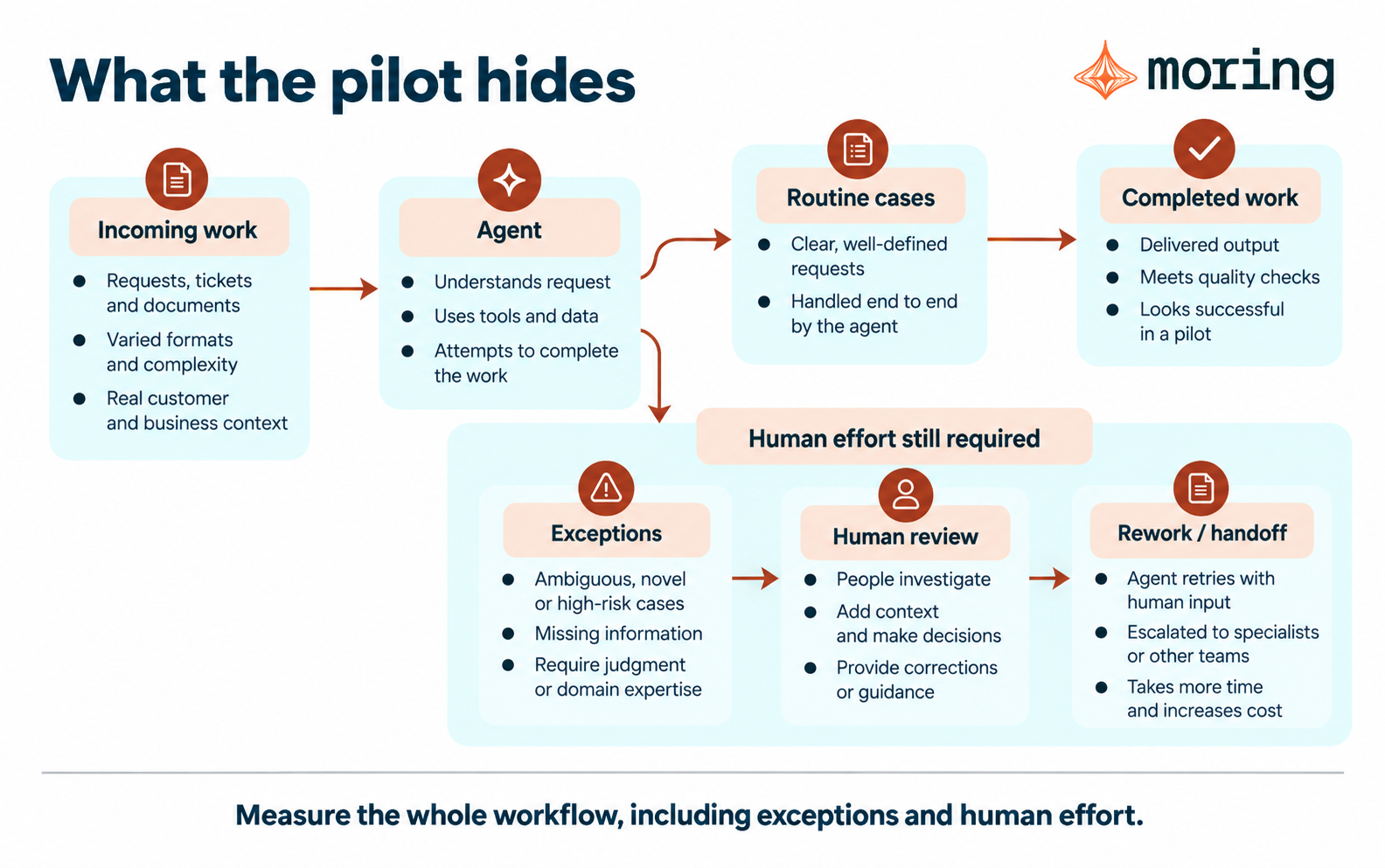
Pilots tend to scope to the easiest, most tractable slice of a process and leave the messy parts, intake, exceptions, handoffs, to people. The result is a demo that maybe saves a few minutes on one step while the total cycle time for the whole workflow barely moves. Deloitte’s Tech Trends research calls this out directly: organizations tend to automate the process they already have instead of redesigning it for an agent, producing what the report calls “workslop,” where a poorly scoped agent adds work instead of removing it.
For example, invoice exception handling. An agent that matches clean and straightforward invoices still routes every hard case into the same queue that was already backed up. The bottleneck doesn’t move; it just gets a new coat of paint.
2. Nobody owns the agent once it’s live
Only 21 percent of surveyed companies report having a mature governance model for autonomous agents, according to Deloitte’s State of AI in the Enterprise 2026 survey of over 3,200 business and IT leaders.
The California Management Review’s framework on governing agentic systems has a line worth repeating: without a clear accountability layer, agents become “organizational orphans,” capable of acting but not owned or controlled. Its fix is simple to state and hard to do: every agent needs a named business owner, a defined risk profile, and a record connecting each decision back to the model version and configuration that produced it. If nobody can answer who’s accountable when this underperforms, the agent doesn’t have an owner. It has a project team that will eventually move on to something else.
3. The agent doesn’t have good data to work with
Salesforce’s engineering leadership has a name for the workaround teams build when this fails: the “prompt doom loop,” where employees keep rewriting prompts to manually feed the agent context it should already be able to reach on its own as Salesforce describes. It’s exhausting, it doesn’t scale, and it’s a big reason pilots stall before they ever get near production.
Deloitte frames the deeper issue as architectural. Conventional ETL and data warehouse patterns weren’t built for the kind of searchable, connected knowledge agents need at runtime, and most companies haven’t rebuilt around that yet. Their 2026 survey backs this up: only 40 percent of leaders rate their data management as highly prepared for AI, a number that dropped from the year before. Technical infrastructure readiness sat at 43 percent, and talent readiness at just 20 percent.
4. It has access, but no real limits on what it can do
There’s a difference between access, what systems an agent can reach, and authority, what it’s actually allowed to commit the company to. Salesforce frames it as API discovery versus API security: knowing an API exists doesn’t mean every agent should be able to call it without restriction as Salesforce describes.
The California Management Review piece pushes this further, arguing that static, role-based permissions aren’t built for a system that can generate actions nobody predicted in advance. What’s needed instead is adaptive: confidence thresholds, behavioral baselines, and what the piece calls guardrail agents that intercept a risky action before it reaches a system of record. In practice, that might look like a claims agent that can approve routine claims under a set dollar threshold on its own but kicks anything bigger to a human, or a procurement agent whose tool blocks spending above its authorized cap and routes the request for review.
5. There’s no real plan for when it gets stuck
Pilots run with a human reviewing every output, which quietly hides the fact that there’s no actual escalation design underneath. Take an IT incident-response agent that triages tickets and resolves the routine ones on its own. Without a real escalation plan, either every ticket still waits on a human, which defeats the point of having the agent, or broken tickets get closed out with nobody noticing until someone complains.
The California Management Review framework describes the shift companies need to make: from human-in-the-loop, where a person approves every action and becomes the bottleneck once you’re running thousands of actions an hour, to human-on-the-loop, where people set boundaries up front and defined exceptions get escalated. Critical actions can still require approval before execution. Salesforce’s own account of scaling internally makes the volume problem concrete. Reviewing every conversation was workable at a few thousand conversations, and it became impossible once volume hit the millions, all while auditors still wanted proof that compliance was being maintained as Salesforce describes. A real fallback plan answers more than who gets paged. It defines what the workflow does while it waits for a human to show up.
6. Teams measure the wrong thing
This is where most of the disconnect between pilot results and production reality lives. Pilot metrics tend to measure whether an individual output looks right. Production metrics need to measure whether the work actually got done correctly, without someone quietly redoing it afterward.
| Dimension | Pilot metric | Production metric |
|---|---|---|
| Quality | Response rated accurate by a reviewer | Resolution rate with no reopened case |
| Completion | Task completed | Correct completion with no downstream human rework |
| Coverage | Success on a curated test set | Success across the live case mix, including exceptions |
| Reliability | Single-step success | Success sustained across multi-step, multi-turn interactions |
| Speed | Response latency | End-to-end cycle time for the full workflow |
| Oversight | Every action human-reviewed | Escalation rate, exception rate, time to human handoff |
| Cost | Project budget | Fully loaded cost per resolved unit of work |
| Risk | No incidents observed during the pilot | Auditable trail, incident rate, time to detect and roll back |
Salesforce’s own CRMArena-Pro benchmark shows why that gap matters. Testing leading agents against 19 expert-validated CRM tasks, it found roughly 58 percent success in single-turn settings, a number that dropped to 35 percent in multi-turn settings, with the agents showing almost no built-in awareness of confidential information. These 2025 results describe the tested agents, not all current systems; conversation turns and workflow steps are different dimensions. Salesforce’s broader point echoes this: a lot of teams ship an agent and can’t tell whether it’s working, because nobody defined a real business outcome for it to hit in the first place.
7. The company never redesigned how the work happens
Beyond task scope, this is about how people’s roles and responsibilities change. McKinsey’s research separates out a group of “high performer” organizations, roughly 6 percent of everyone surveyed, and finds they’re nearly three times more likely than everyone else to have redesigned individual workflows around AI instead of layering it on top of the old process. Out of 31 organizational factors McKinsey tested, that redesign had one of the strongest connections to real business impact. The same high performers were also three times more likely to say senior leaders demonstrably own the AI initiative, not just fund it.
Most companies aren’t there yet. Deloitte’s 2026 survey found 84 percent of organizations haven’t redesigned jobs around AI capabilities at all, even though 82 percent expect at least 10 percent of their jobs to be fully automated within three years. That gap, expecting the disruption but not preparing the operating model for it, is close to the whole argument of this article in one statistic.
It’s worth separating two things that get blurred together constantly: deploying an agent and actually making money from it. McKinsey found that only 39 percent of companies attribute any EBIT impact to AI at all, and most of those say it’s under 5 percent. Deloitte found 74 percent of companies hope AI will grow revenue eventually, compared with just 20 percent who say it’s happening now. Both numbers describe enterprise AI broadly, not agents specifically, but the pattern holds. Getting something deployed and getting a return from it are two different milestones, and treating them as the same one is how expectations get ahead of reality.
A seven-question production-readiness check
Before calling a pilot ready to scale, it’s worth running it through a short list of questions a demo can pass without ever answering.
-
Can we name the end-to-end workflow this agent owns, including its trigger, its exception paths, and its definition of done?
-
Who is the named business owner accountable for its outcomes, and who has the authority to shut it off?
-
Can it pull what it needs from real systems of record on its own, or is someone still hand-feeding it context through prompts?
-
What is it actually allowed to commit the company to, up to what limit, and what still requires a human sign-off?
-
What happens the moment it’s uncertain or wrong, and how quickly does a human get the full context to fix it?
-
Are we measuring correct completion with no rework required, checked against the real case mix, not just the demo set?
-
What roles, targets, or processes actually changed because this agent exists?
Most of these questions point at the same underlying gap: permission enforcement, monitoring, evaluation, escalation, and an audit trail that can survive a real review. That’s the practical reason a category like an AI control plane exists, a layer that applies those controls to agent actions routed through it, instead of solving them one pilot at a time. Platforms like MORiNG’s are built around that idea, but the requirement itself doesn’t depend on any specific vendor. It’s the same seven gaps, whichever agent framework or model happens to be underneath. Ownership, data quality and job design still require organizational decisions.
None of this means agent pilots are a waste of time. It means a good pilot answers one question, can the model do the task, while production asks a completely different one: can the organization run this reliably, with accountability, at scale. Confusing the two is probably the single biggest reason so many promising pilots never make it past the demo.
For implementation steps after identifying the gaps, see our 90-day rollout plan for enterprise AI agents.